Thigh tattoos get one of the biggest, softest and easiest-to-cover canvases on the body, so almost any idea can fit. This guide from Holistic Ink in Boston shows 10 designs with real meanings, then helps you pick a style, a spot on the leg and a care plan that works for your skin. Read it before you book a consultation, and you’ll walk in with a clear idea instead of a blank page.
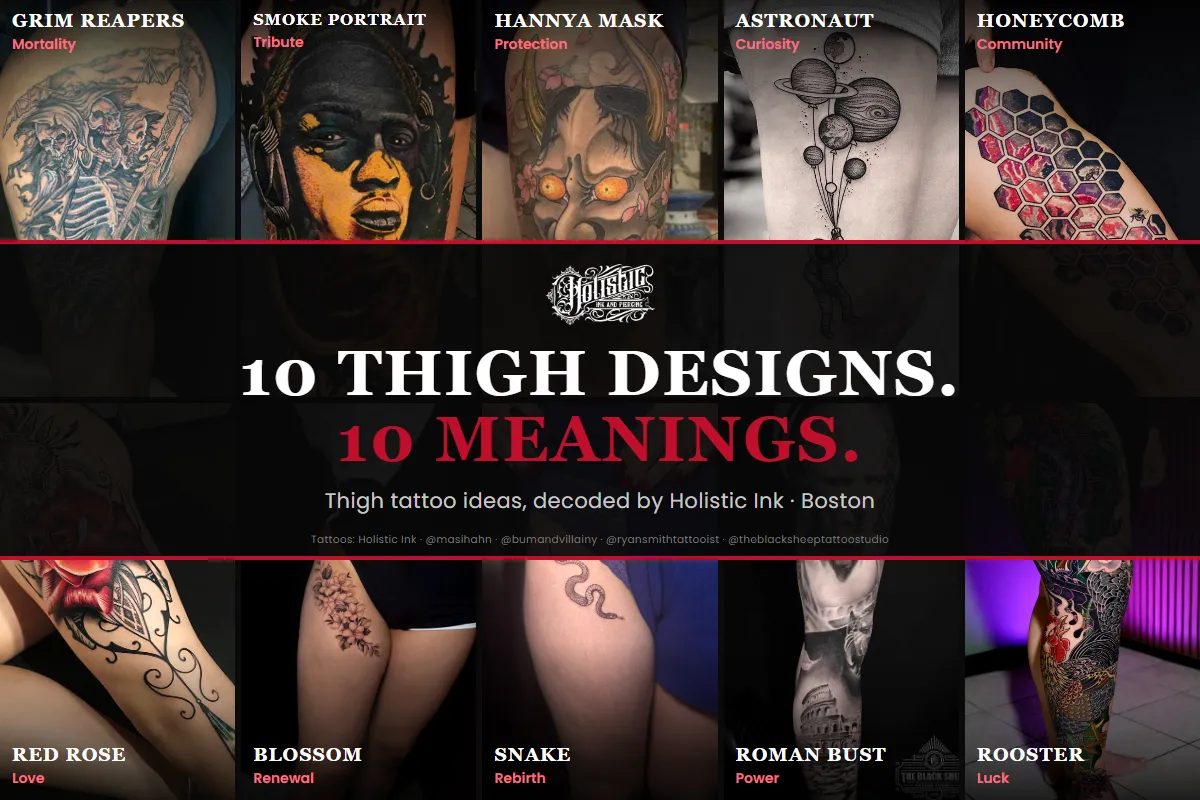
Thigh Tattoos Ideas and Their Meanings by Holistic Ink
The thigh holds a large piece without crowding. Clothing hides or shows it whenever you like. That flexibility is why the 10 designs below range from small florals to full leg sleeves. Some are real work from our Boston studios, and the rest come from artists whose work the Holistic Ink team admires. Each one explains what it means and who it’s perfect for.
Black and Grey Realism Grim Reapers on the Outer Thigh
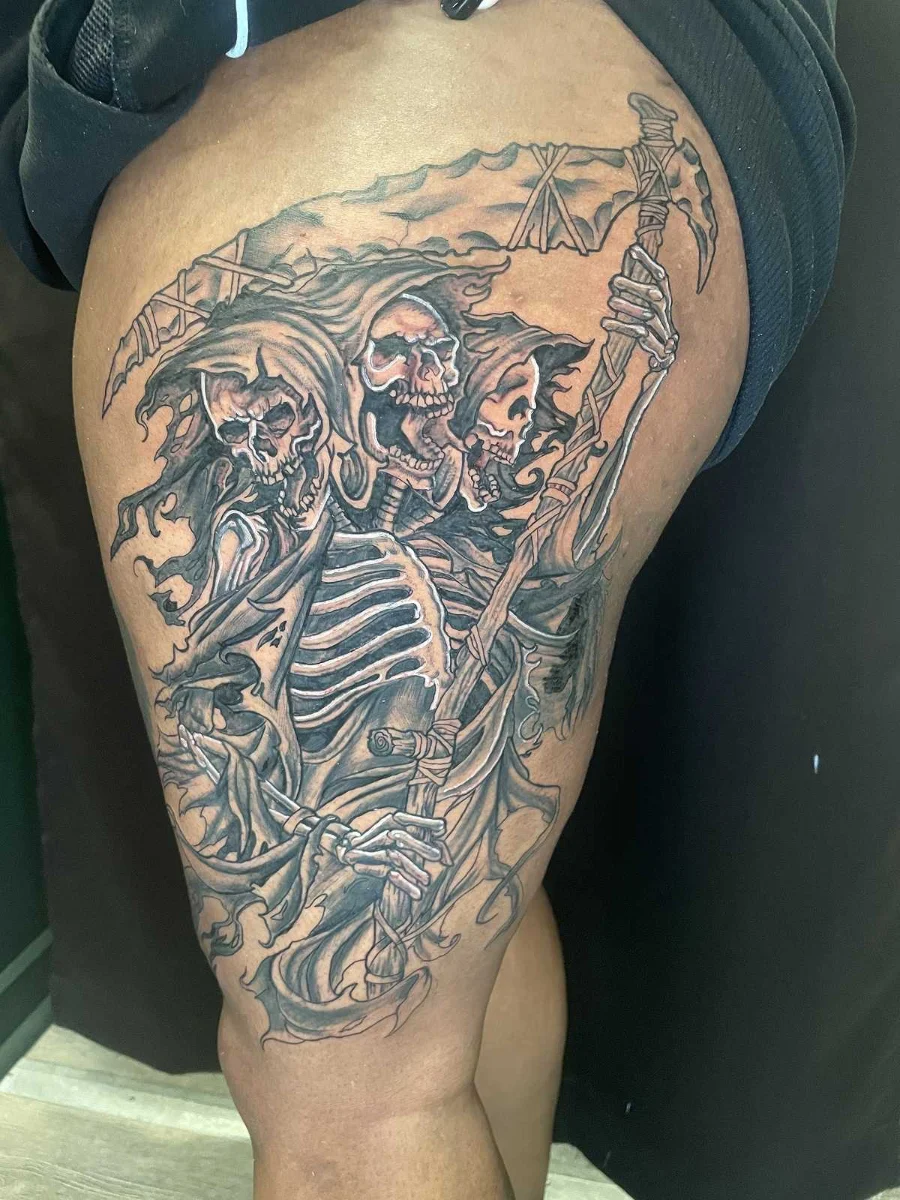
Three skeletal reapers with scythes run from the hip down the outer leg in this piece by Manny Tatsu, one of our Boston artists. The shading is pure black and grey, with deep shadows in the robes and bright bone highlights that keep each figure readable. Grim reapers stand for death, the passing of time and the fact that nobody escapes it, which is why they often mark a loss or a second chance. The long outer thigh gives the scythes room to run in a line. Anyone who wants a dark, dramatic design that reads from across the room will like it.
Color Realism Portrait With Smoke on the Front Thigh
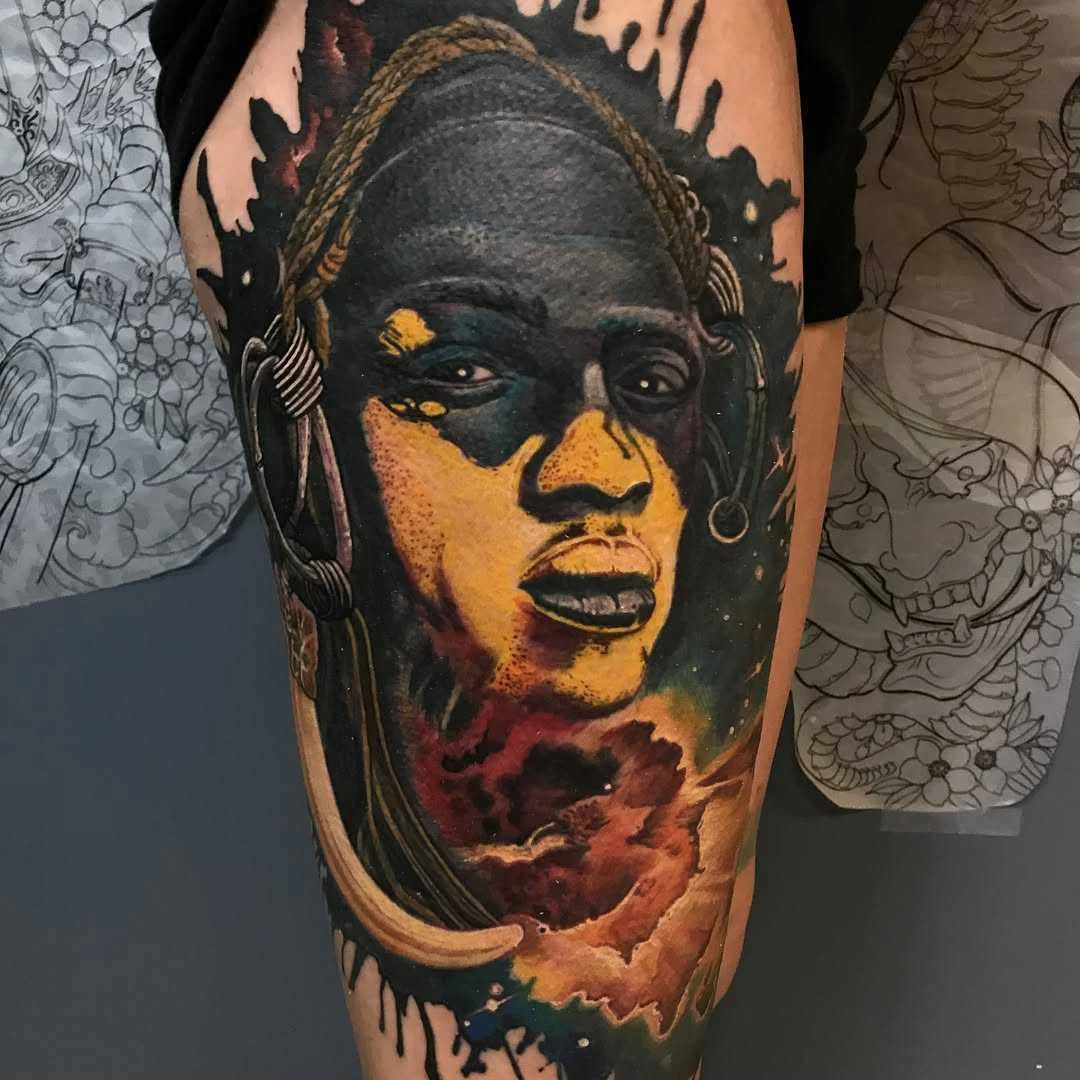
Vinny Nguyen drew a color portrait of a man across the front of the leg, set against orange and yellow smoke. The smoke blends from deep red to gold behind the face, so the skin tones stand out and the figure seems to step out of a fire. Portraits like this usually honor a person, whether that’s a lost relative, a hero or a version of yourself. The smoky background also softens the edge between the design and bare skin, which keeps it from looking like a sticker. Pick it for a tribute that glows, and expect a long session.
Japanese Hannya Mask With Cherry Blossoms
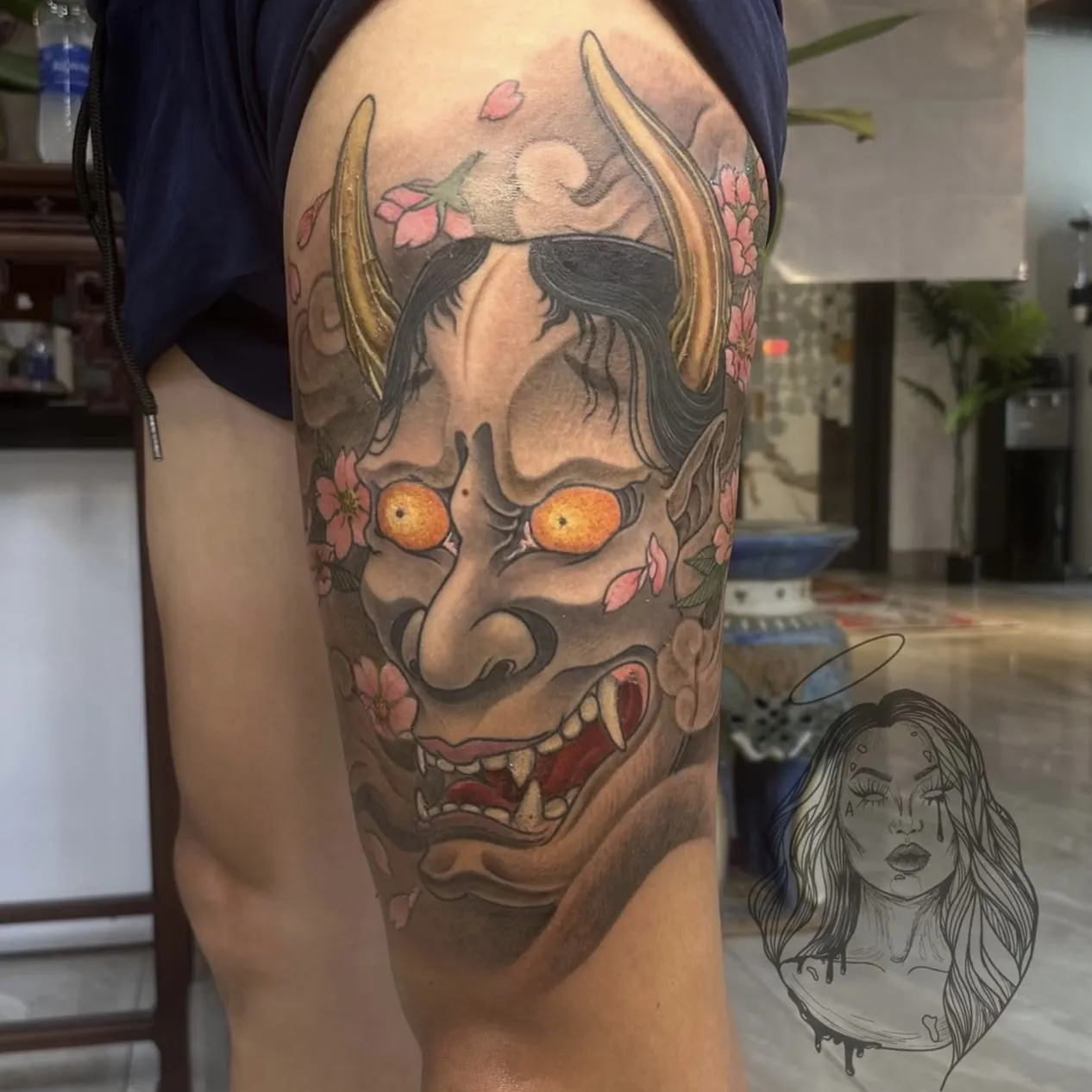
Angie Nguyen drew this Hannya mask in heavy black outlines, with golden horns, orange eyes and cherry blossoms all around it. In Japanese theater the Hannya is a woman whose grief and jealousy turned her into a demon, and in irezumi it points to protection and to strong emotion turned into something useful. The blossoms add the quiet side, a reminder that life is short and beautiful. Bold outlines hold up well on the front and outer leg, where clothing shields the skin from most sun. It’s a great choice if you want a design with a serious story and room to grow into something bigger.
Fine Line Astronaut With Planet Balloons
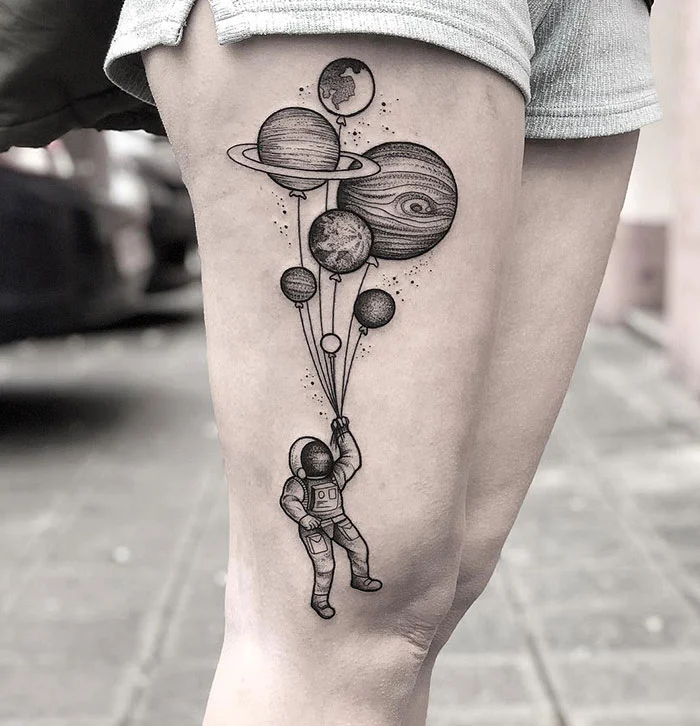
An astronaut drawn in thin, clean lines floats down the front of the leg and holds a bunch of planets like balloons, in a design by @masihahn. Light dotted shading gives the suit a soft texture without heavy black. The mix of space and play points to curiosity and the urge to reach higher while keeping a sense of humor. That long, narrow shape follows the leg. The planets can rise toward the hip as far as you want. Dreamers and space fans tend to choose it, and so does anyone after a gentle tattoo with a story.
Honeycomb Galaxy on the Hip and Upper Thigh
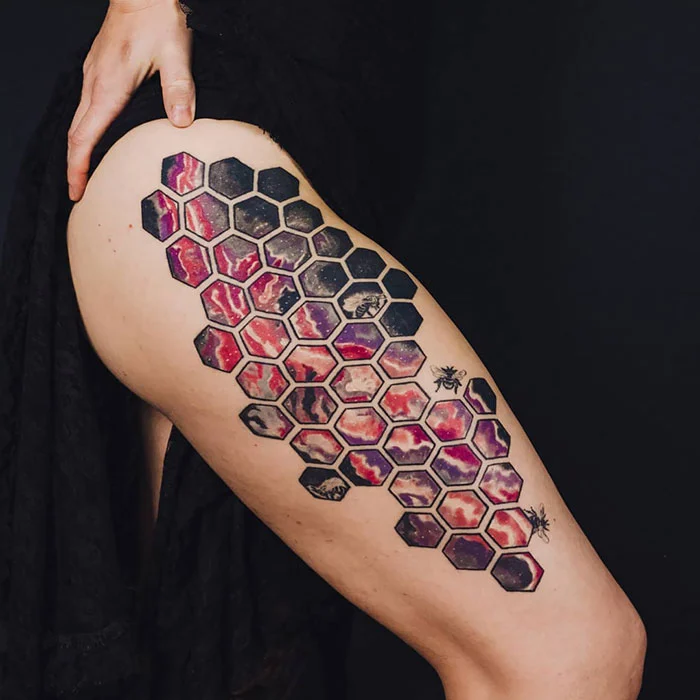
Hexagon cells open onto a pink and purple galaxy, with small bees dotted around the edges, across the hip and upper leg in this piece by @bumandvillainy. The bees stand for community and hard work, while the galaxy adds the sense of something far bigger than one hive. Color blends through the cells, which makes the geometric shape feel soft. Hips and upper legs bend with every step, so a pattern whose edges follow the curve works well here. Choose it if you love nature or the idea of a team.
Neo-Traditional Red Rose With Ornamental Swirls
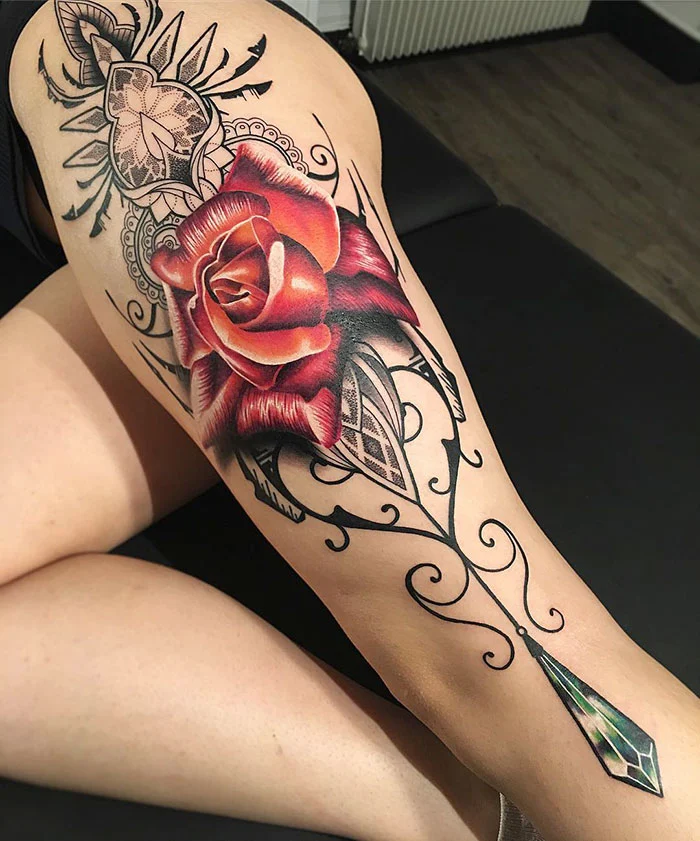
A large red rose, framed by swirling vines and a blue gem, runs down the outer leg toward the knee in this neo-traditional piece by @ryansmithtattooist. Bold outlines and rich red keep the flower punchy, and the ornament fills the space around it. The rose means love, beauty and the tension between softness and thorns, and the gem adds a hint of treasure. Because the outer leg is flat, the whole flower shows. It’s a classic pick for anyone who wants femininity with some edge and a design that reads clearly from a distance.
Small Blossom Branch in Fine Line
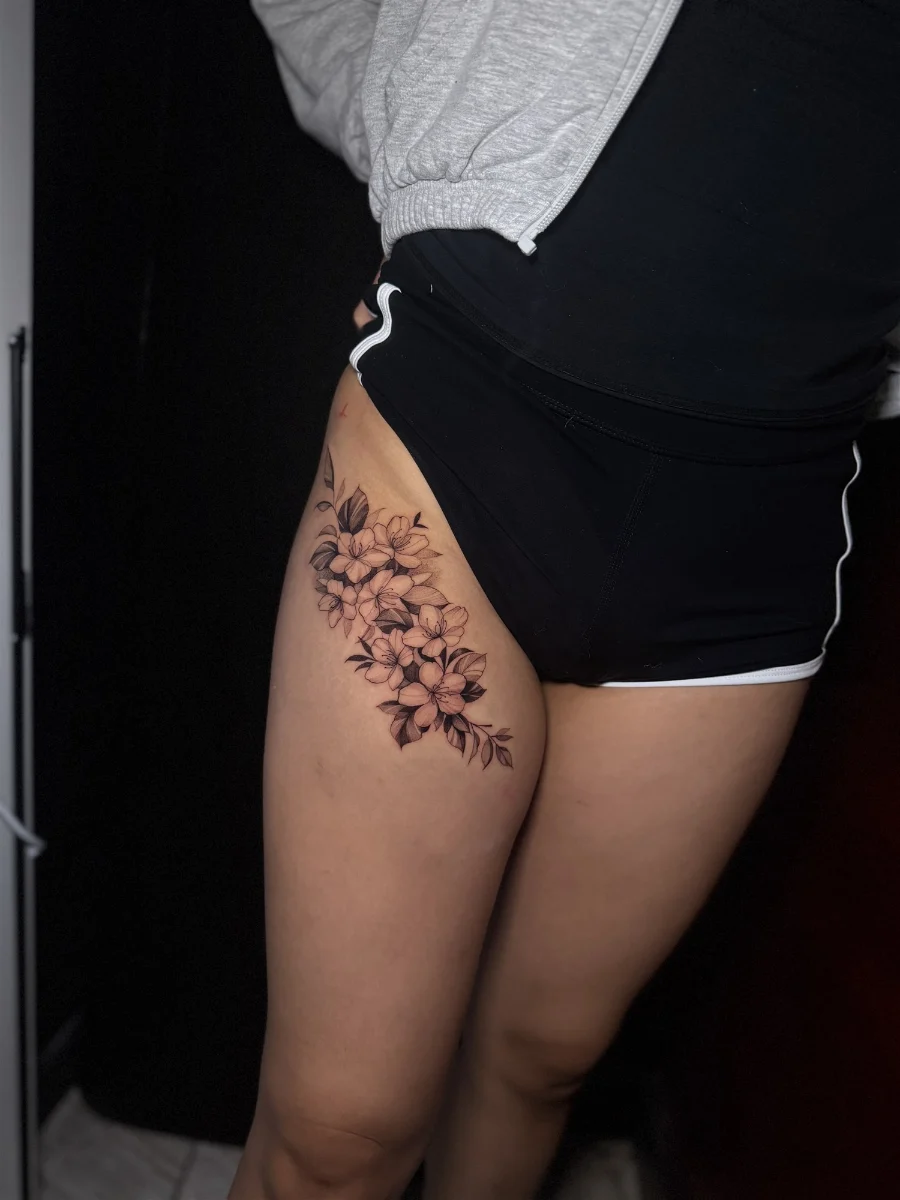
A single blossom branch in fine line sits high on the leg, with a lot of bare skin left around it. This one was shared in a client review of Vinny Nguyen’s work. Blossoms stand for gentle beginnings and renewal, and a small branch says it quietly. Because the design is light, it usually asks less of your skin than a big piece, which helps a lot at a first visit. Thin lines do need an artist who controls depth, so ask about it at your consultation. First-timers love it, and so does anyone who prefers a subtle piece that clothing hides with ease.
Fine Line Snake on the Upper Thigh
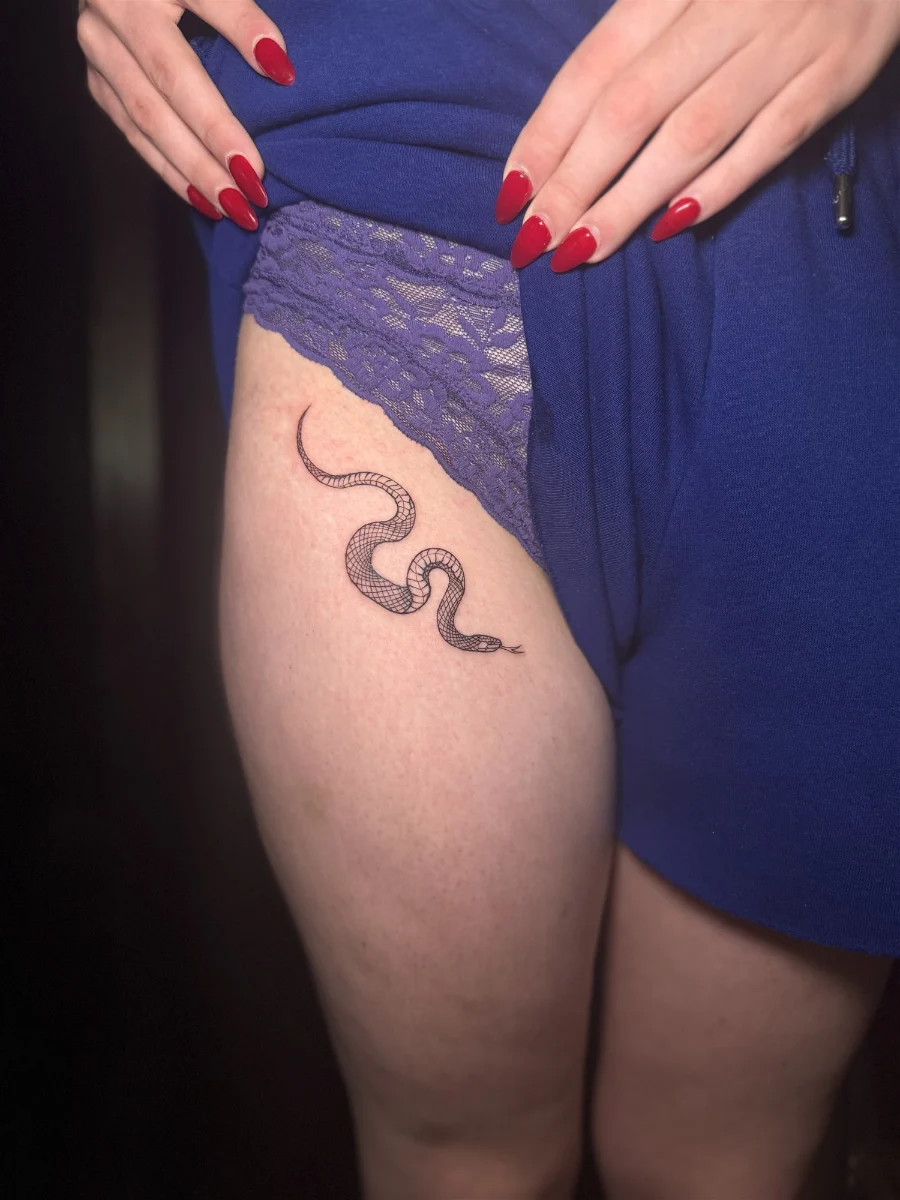
A small black snake curves in an S shape near the hip and upper leg, drawn in fine line by Vinny Nguyen and shared in a client review. Snakes mean rebirth, since they shed their skin, and they also carry a sense of protection. The curve follows the line where the leg meets the hip, so the design moves with the body instead of fighting it. It’s easy to cover with shorts or a swimsuit when you want privacy. It’s perfect for anyone who is coming out of a tough stretch and wants something small that still carries real weight.
Roman Bust Sleeve Reaching the Calf
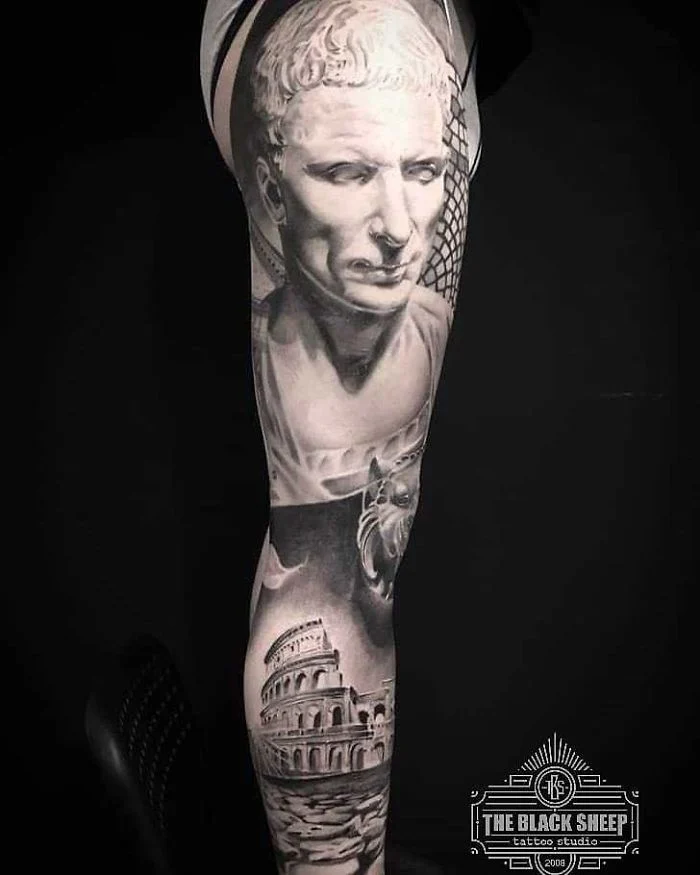
A marble bust of a Roman figure sits on the leg and a Colosseum rises on the calf below, forming one black and grey sleeve by @theblacksheeptattoostudio. The shading makes the stone look carved, with soft shadows around the face. Roman busts stand for power, history and ideas that outlast a person, and the Colosseum adds endurance. Staggered heights guide the eye down the leg. History lovers will enjoy it, though a sleeve like this takes patience and a steady plan.
Rooster and Centipede Irezumi Sleeve
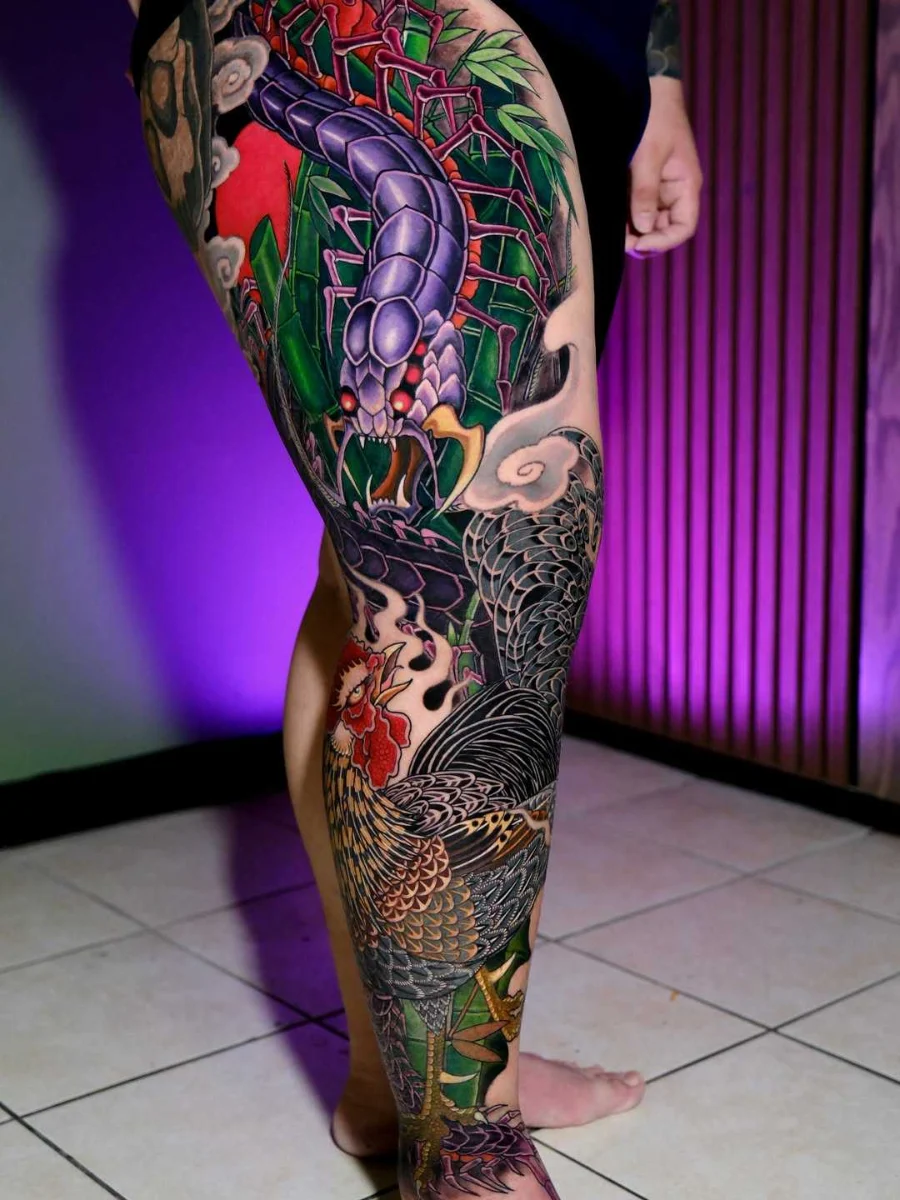
A rooster and a centipede share a Japanese sleeve that runs from the thigh to the calf, set against waves and clouds, by Vinny Nguyen. The background shapes, wind bars and bold outlines are classic irezumi, and they tie both animals into one story. In Japanese art the rooster stands for good fortune. The centipede means protection and forward drive. A long, flowing background is what makes a sleeve readable, and the thigh gives it the width it needs. It’s the right call for someone ready for a large commitment and a full story.
Choosing a Style for Your Thigh Piece With Holistic Ink
Three styles shape most of the work that leaves our Boston studios, and each one behaves differently on a large, curved canvas like the leg. The table gives the short version. Below it, the notes explain where each style shines and where it falls short, so you can match the style to your idea instead of the other way around.
| Style | How the thigh piece looks | Best size and placement | How it ages | Best for |
|---|---|---|---|---|
| Black & Grey Realism | Soft shading, real depth, no color | Large pieces on the outer or front leg | Holds well when the contrast is strong | Animals, portraits and dark, serious imagery |
| Color Realism | Rich, blended color with natural highlights | Front and outer leg, where the color has room | Lasts best with sun protection | Portraits, characters and bright symbols |
| Japanese / Irezumi | Bold outlines, wind bars and flowing backgrounds | Thigh-to-calf plans and full leg sleeves | Reads clearly for years | Big, story-driven projects |
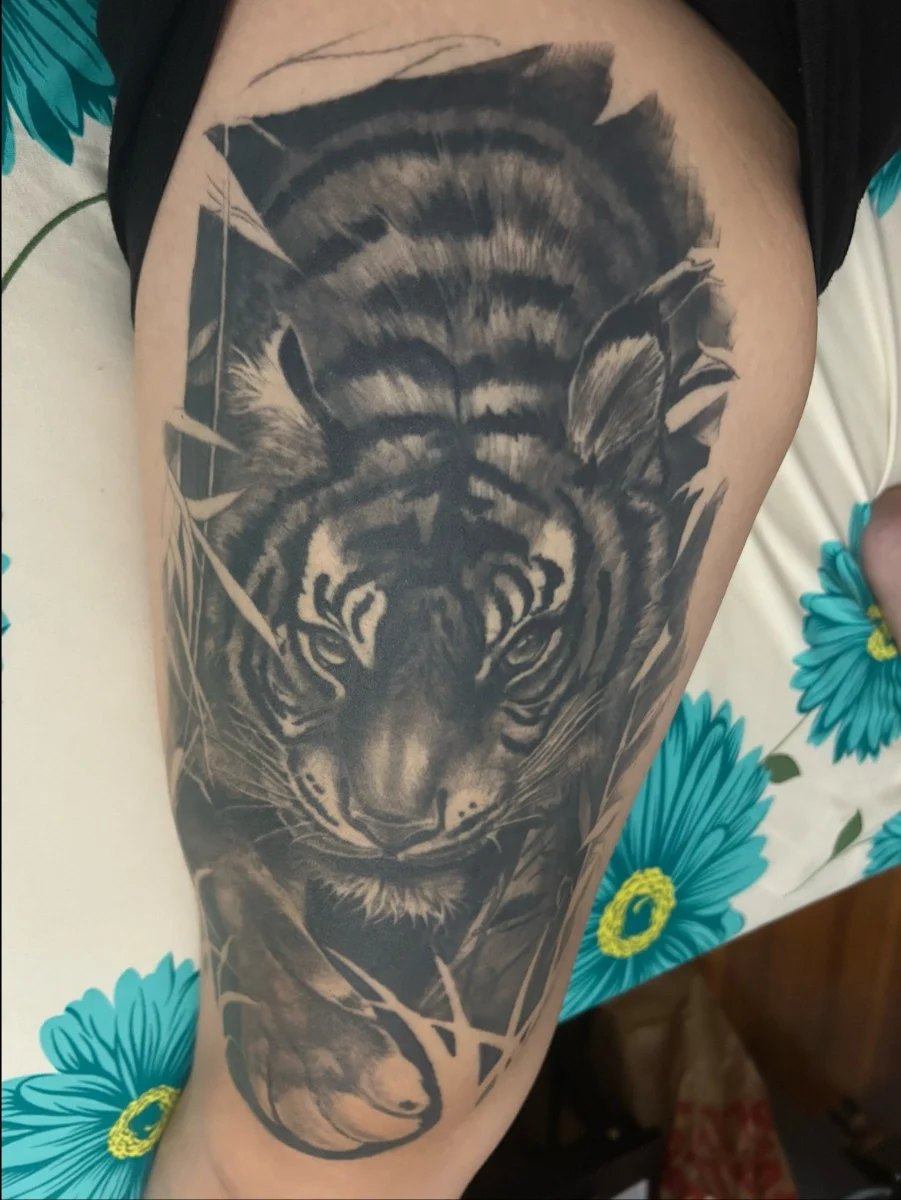
Black and grey realism builds depth with layered shading, so a tiger’s face or a flower looks almost three-dimensional. The advantage over line-only styles is contrast, which keeps the design readable as the skin changes, and the benefit for you is a calm, serious look that still works from a few feet away. It needs space, and the outer leg offers plenty. It’s not ideal if you want a palm-sized portrait with tiny details.
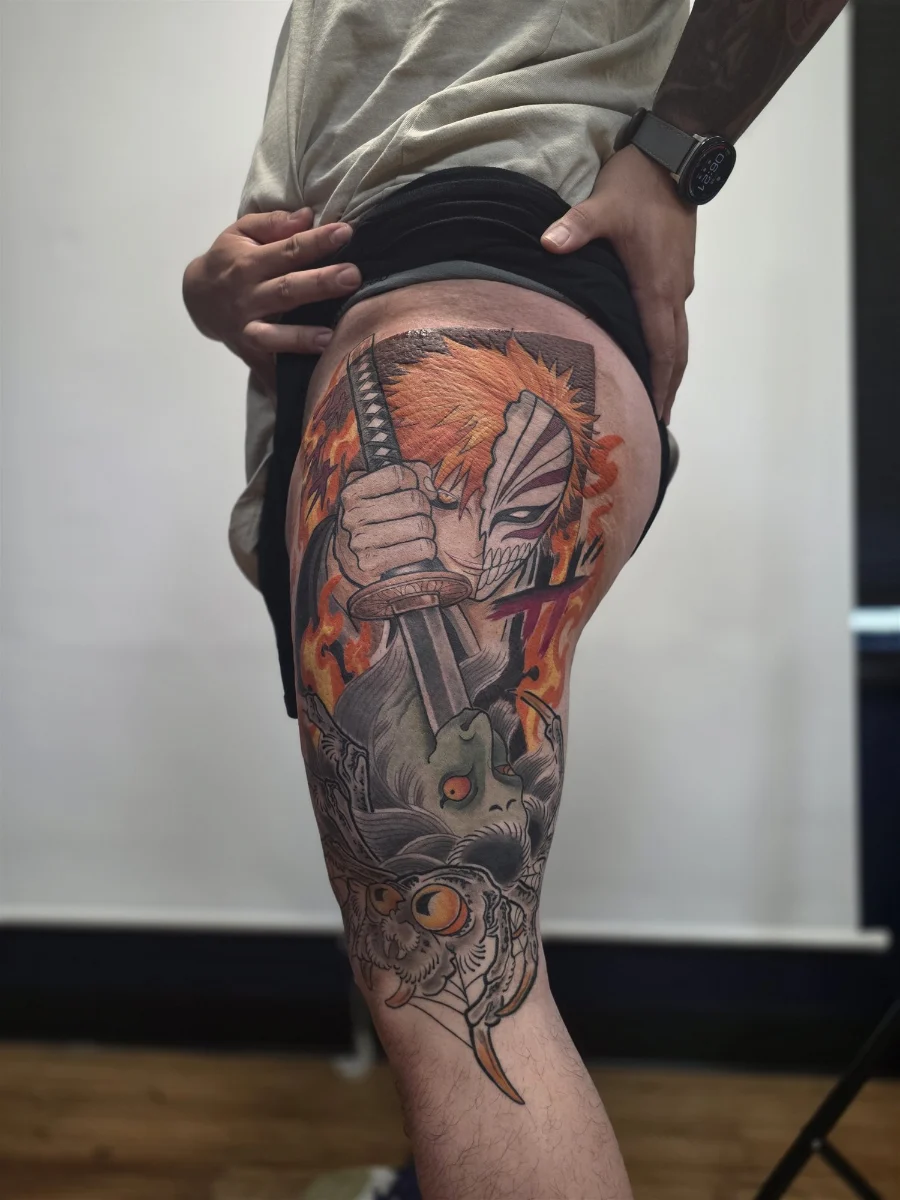
Color realism blends pigment so reds, oranges and blues look lit from within, as in this swordsman surrounded by flames. Compared with flat color, the layered approach gives characters and flowers real life. You get a design that pops against bare skin. Holistic Ink artists often suggest it for people who want a tribute or a favorite character in full color. It asks for good sun habits, since bright colors fade faster without them.
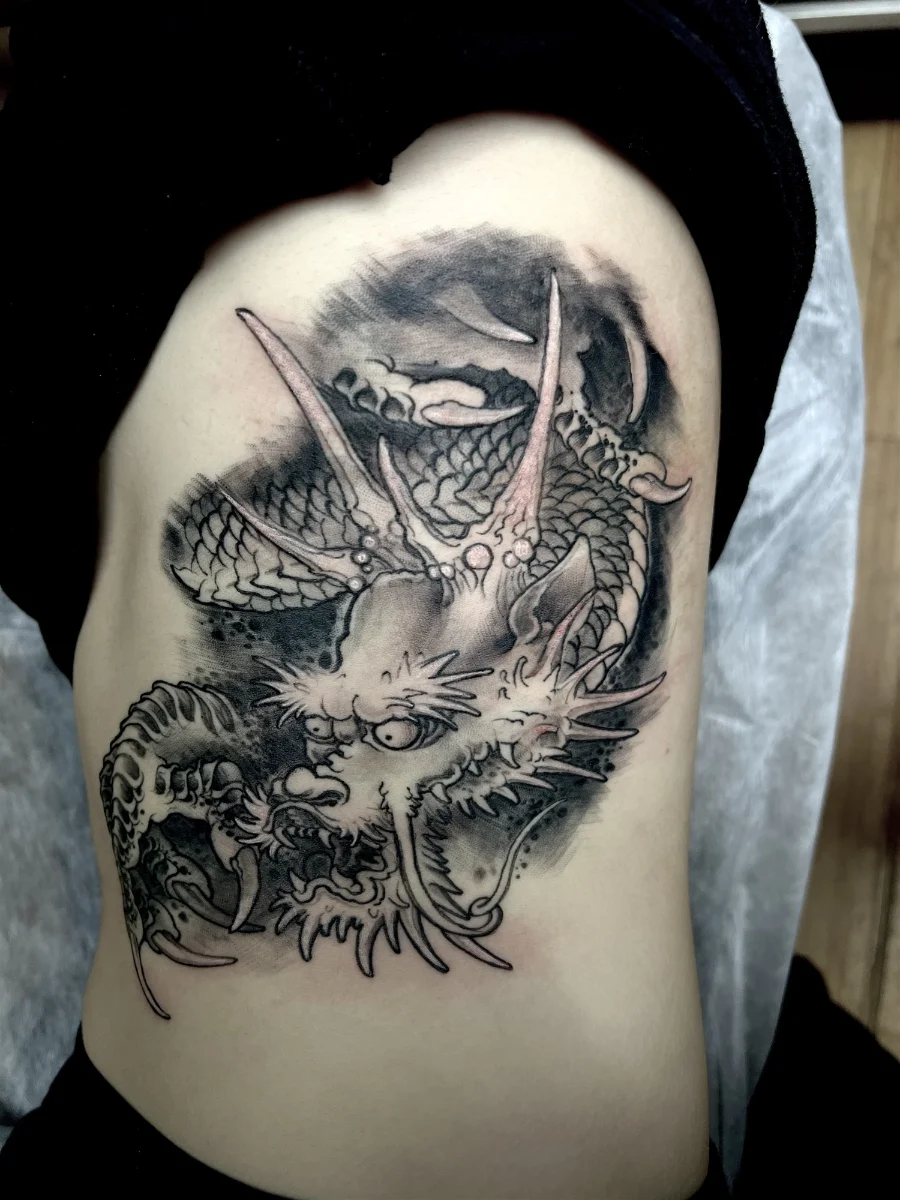
Japanese work uses bold outlines, wind bars and flowing backgrounds so that a big design stays legible for years, and a dragon wrapped around the hip shows how well it follows the body. The advantage is storytelling on a large scale, and the benefit is a piece that grows into a full sleeve without looking pieced together. It’s not ideal for tiny, fast projects, because the style depends on the background.
Fine line and neo-traditional styles also look great on the leg. Fine line suits small, quiet ideas and first visits, while neo-traditional gives you bold color and strong outlines with a bit of decoration. Ask your artist which one fits your idea best.
Common Mistakes, Pricing Factors and Long-Term Durability
Most regrets about a leg piece come from planning, not from the needle. A few habits cause the majority of problems, and almost all of them are easy to avoid. Run through this list before you commit:
- Don’t pick a design from a flat photo without checking how it wraps around the leg.
- Avoid tiny, crowded details, since small lines blur together as the skin ages.
- Insist on a stencil check while you stand and while you sit, because the leg changes shape.
- Skip the cheapest quote, since low prices often mean rushed shading and weak line work.
- When a sleeve is the goal, plan the thigh section so it connects to the rest.
Price depends on size, level of detail, color, the number of sessions and the artist’s experience, and an honest quote only comes after the artist sees your design and the exact spot. That’s why Holistic Ink prices pieces at a consultation instead of guessing from a photo. Bring reference images and ask for a session estimate. It’s a good fit for anyone who likes to budget early, and it keeps surprises off the table.
Durability depends on what the skin meets every day. Jeans and leggings rub the outer and inner leg, and sun fades color on days in shorts. Weight or muscle changes can also stretch a design over time. Daily sunscreen once the skin has healed protects the ink, and a touch-up years later is normal for large color areas. Old pieces can often be covered with a darker, larger design, so ask the artist about a cover-up before you give up on them.
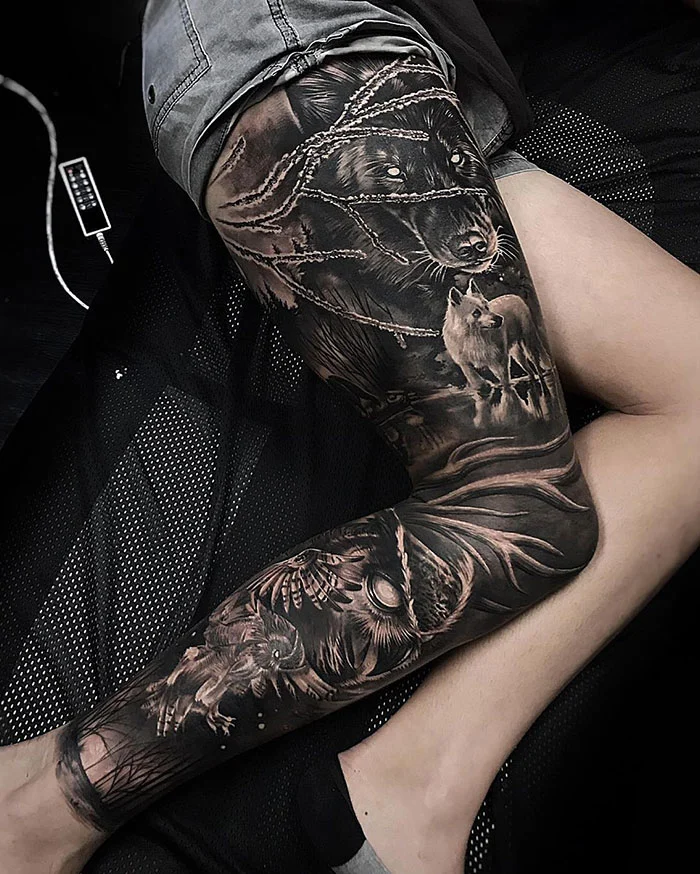
This forest sleeve shows what good planning looks like on a long surface. The shading flows from one animal to the next with no breaks, so the whole leg reads as one piece instead of a stack of patches.
Placement Guide for the Front, Side, Back and Inner Leg
The thigh isn’t one spot but several. Each one changes how a design looks, how it feels and how it ages. Front and outer areas give the flattest surface, while inner and back areas ask more from you and from the artist. Use the table to match the spot to your idea.
| Area | Pain level | Design that fits | Style that suits |
|---|---|---|---|
| Front of the leg | Low | Portraits, large florals, animals | Black & Grey Realism, Color Realism |
| Outer leg | Low | Long vertical designs such as roses, snakes and leg pieces | Japanese / Irezumi, neo-traditional |
| Upper leg and hip | Moderate | Florals, geometric patterns, small animals | Fine line, Color Realism |
| Back of the leg | Moderate | Symmetrical patterns, mandalas, wide ornaments | Black & Grey Realism, ornamental work |
| Inner leg | High | Small, simple pieces | Fine line, minimal black work |
| Just above the knee | High | Bold shapes with strong outlines | Japanese / Irezumi, neo-traditional |
Pain varies by person, so treat the table as general guidance only. Plan around your own schedule too, since work shorts or a summer trip can change which spot makes sense. Your own skin and your artist’s technique both change how a session feels.
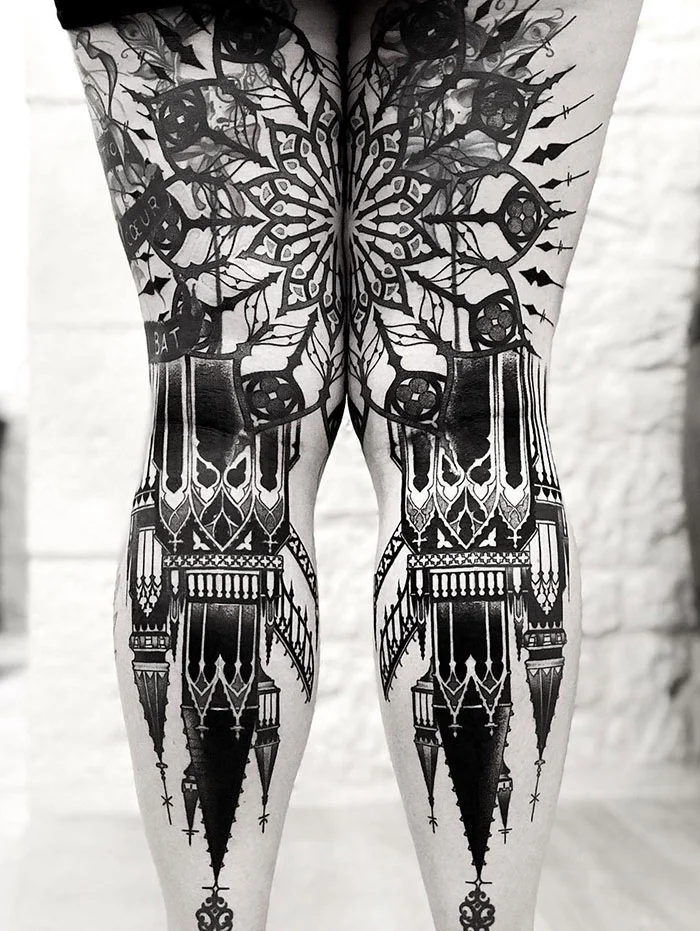
The back of the leg suits symmetrical and ornamental work, since both sides get seen together in a mirror or on a beach. This medieval pattern shows how a repeated shape fills the area from the hip down. The skin here is softer, so ask your artist how to plan around the crease under the buttock, where the design gets folded every time you sit.
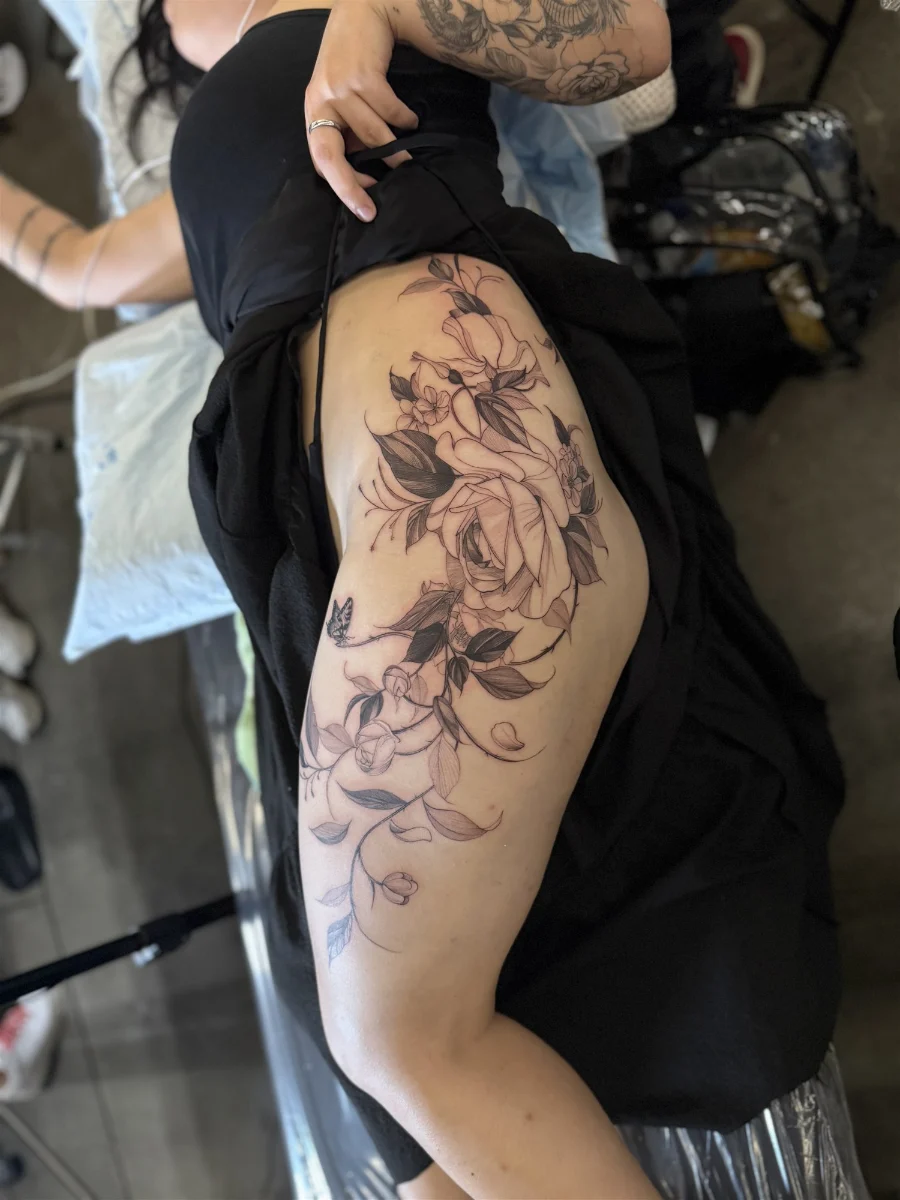
The hip and side of the leg suit long, flowing shapes, and this rose vine from a client review shows the idea. The vine follows the line from the waistband down to the outer leg, so it looks natural from the front and from the side. Not so on the inner leg. It’s tender and rubs against the other leg with every step, so keep designs there simple and expect a slower heal.
Your Tattoo Journey From Consultation to Healed Skin
Every large piece follows the same steps, and knowing them makes the day feel calm. At Holistic Ink the process starts with a consultation, where the artist looks at your idea, your reference images and the exact spot on the leg. You talk about size, style and how the design will flow with your muscles.
Next comes the stencil, a thin print of the design placed on your skin. Stand up and sit down while the artist checks it. The leg looks different in each position. Move the stencil until it feels right, because a few minutes of adjusting now saves years of second-guessing. Speak up, since nobody minds a redo. The session itself starts with the outline, then moves into shading and color. Bring water and a snack, and ask for a break when you need one.
Aftercare begins the moment the artist wraps the piece. The first 2 weeks matter most. Leg skin takes a beating from clothes and movement, so keep this list handy while it heals:
- Wash and dry the area the way your artist showed you.
- Put on a thin layer of moisturizer, not a thick coat.
- Wear loose pants or shorts so fabric doesn’t rub the fresh ink.
- Stay out of the sun and any pool or ocean water until it’s healed.
- Skip heavy leg days at the gym until the skin calms down.
- Don’t pick or scratch the flaking skin, since that can pull ink out.
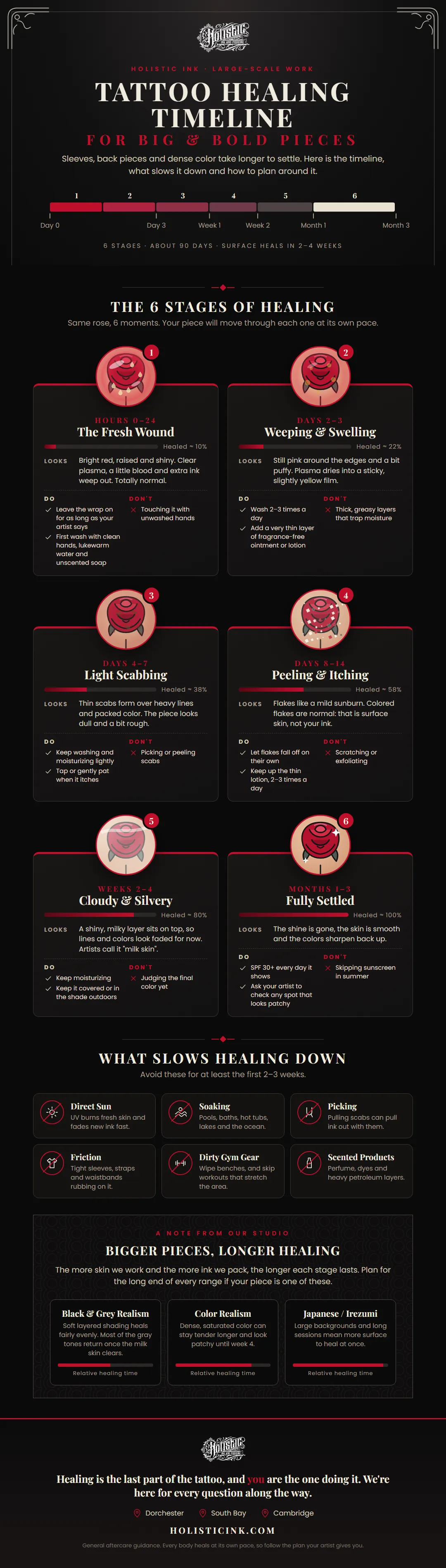
Long-term care is simple. Use sunscreen on healed skin, moisturize now and then, and book a touch-up if a line or a patch of color softens. Large pieces heal in stages, so the infographic below shows the timeline for big and bold work and what can slow it down.
Quick Answers Before You Book
Are thighs painful for tattoos?
Many people find the thigh one of the easier large areas, especially the front and outer sides, while the inner leg and the spot above the knee sting more. Eat before your appointment and breathe through the outline, which is often the sharpest part. Tell your artist if you need a pause.
How much should a piece on the thigh cost?
The price depends on size, detail and how many sessions the work needs, so no honest number exists until an artist sees the design and the spot. Bring clear reference images to a consultation, ask for a session estimate and compare the quote with the artist’s portfolio, rather than the total alone.
How long does a thigh piece take to heal?
The surface usually settles within a few weeks, but the deeper layers of skin keep healing for a couple of months. Large color areas can take longer, and so can spots that rub against clothing. Follow the aftercare list, watch for signs that something is wrong and ask your artist when to check in.
Can a large piece be done in more than 1 session?
Yes, and large work almost always is. Artists split big designs into sessions so the skin can rest and each stage can heal properly. Outlines usually come first, with shading and color following in later visits. Your artist will map the plan before you start.
Ready to Start Your Piece With Holistic Ink
Good leg work starts with a clear idea. Add a style that suits it and a spot that makes sense for your body. You’ve now seen 10 designs with real meanings and the 3 styles our artists specialize in. You’ve also got the placement and aftercare steps that protect the result. If something here sparked an idea, bring it along, and book a consultation to talk through size, style and timing with an artist in Boston.
Ready for a bigger piece?
Our artists are known for large-scale work in 3 styles. Start with the one that fits your idea:
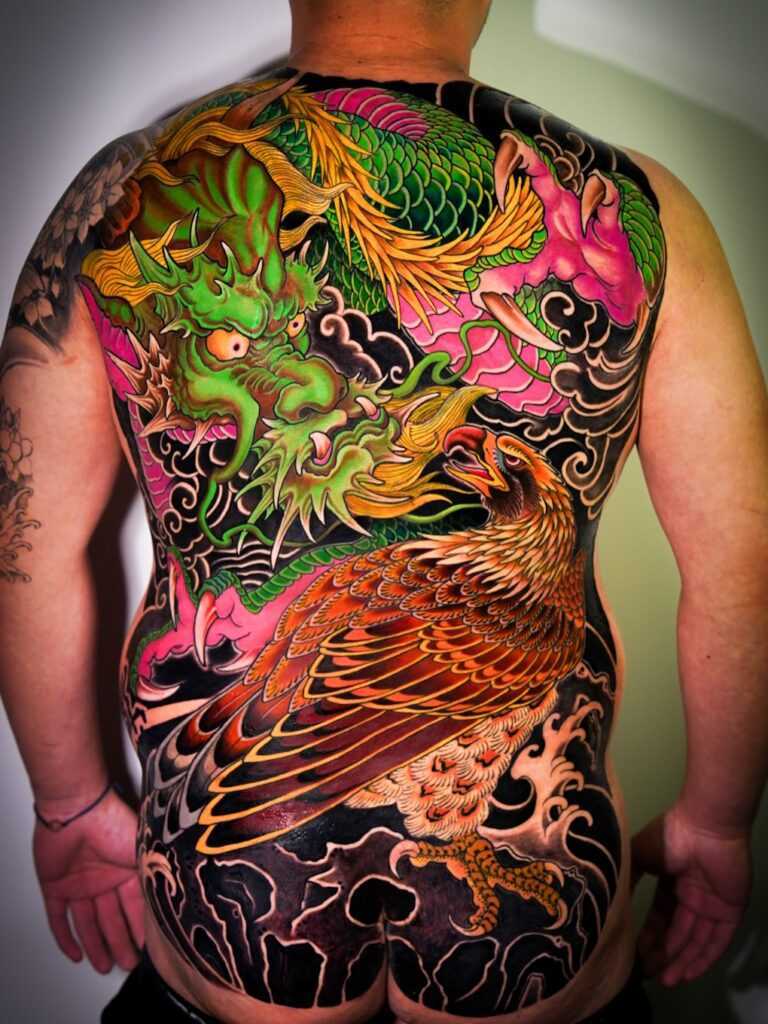 Best matchJapanese IrezumiDragons, koi, deities and full backpieces with traditional flow.
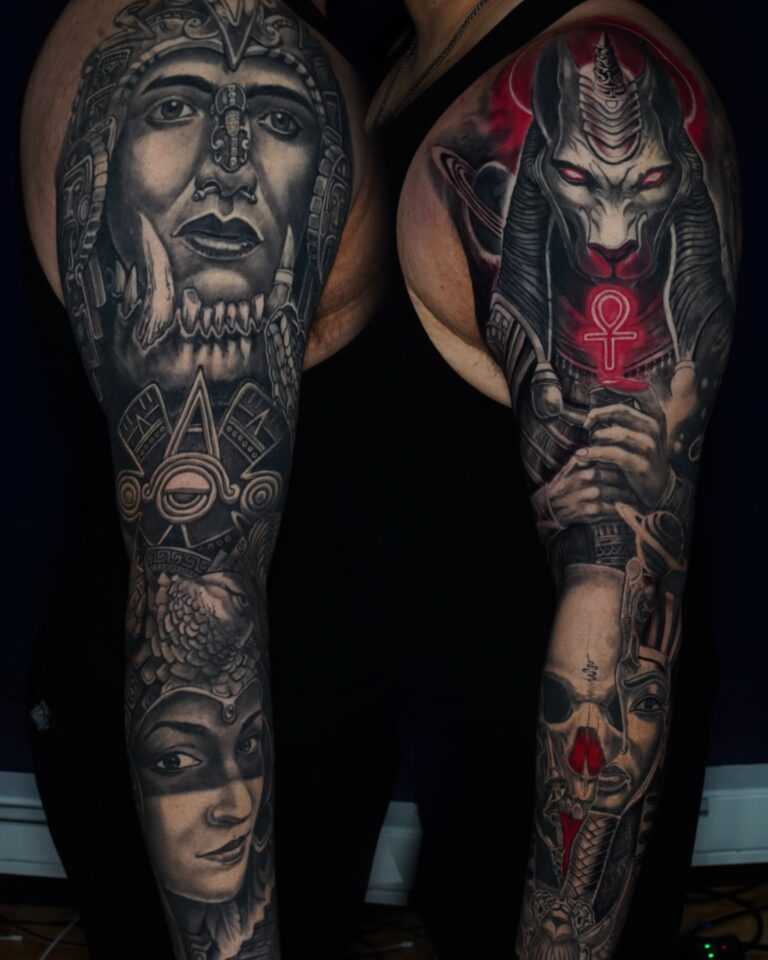 Black & Grey RealismPortraits, animals and sacred art in soft, deep shading.
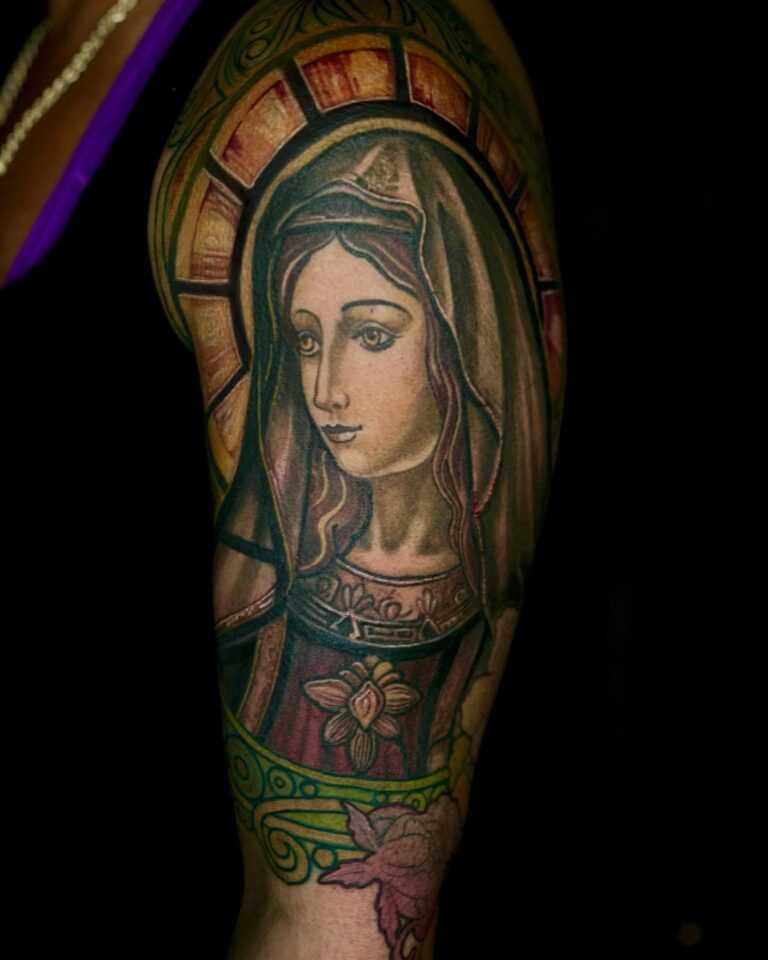 Color RealismSaturated, lifelike color for sleeves and large scenes.Signature project · Japanese IrezumiDragon Backpiece: 66 Hours, 3 Artists, Best of ShowPlacementFull backTime66 hours over 3 daysArtists3 artists, including Vinny NguyenSee the full project →
Bring your reference and placement. We plan large work session by session with you.
We also tattoo American traditional, fine line, script and small tattoos. Browse all styles →