A Buddha face with closed eyes and a serene expression is a popular choice for people who want a daily reminder to slow down, which is why a buddha tattoo appeals to so many. This guide from Holistic Ink in Boston walks through 10 designs, explains what each one means, and shows how to place the piece with respect so it holds up for years.
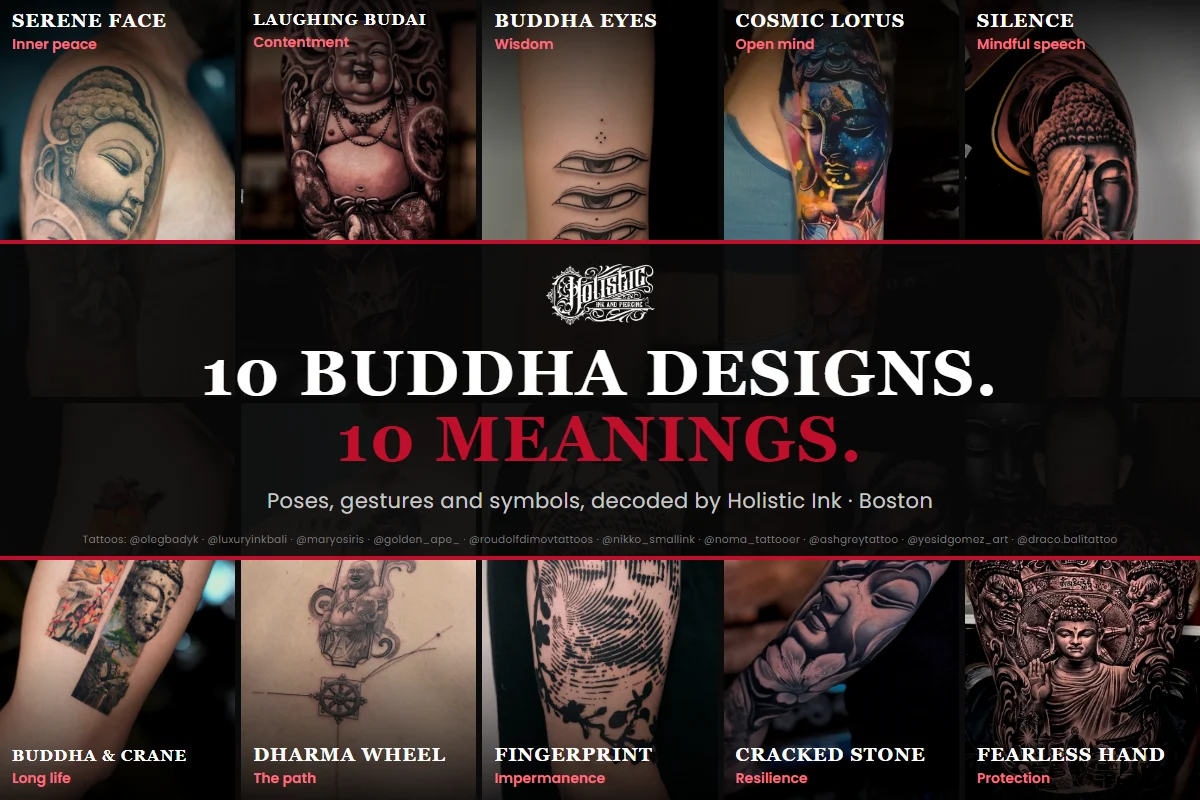
10 Buddha Tattoo Ideas With Meaning From Holistic Ink
Two different figures sit behind most Buddha designs. One is Siddhartha Gautama, the teacher said to have awakened under a tree, usually shown calm with closed or lowered eyes. The other is Budai, the round, smiling monk known as Hotei in Japan and often called the laughing Buddha in the West, who is tied to contentment and good fortune in folk tradition. They carry different meanings, so decide which one you want before anyone draws a line. Pose and hand gesture, called mudra, add a message of their own, and the table sums up the most common ones. At Holistic Ink, a consultation often starts by sorting this out.
| Pose or gesture | What it means | Design idea |
|---|---|---|
| Dhyana mudra (hands resting in the lap) | Meditation, focus | Seated Buddha on a lotus |
| Abhaya mudra (raised open palm) | Fearlessness, protection | Standing Buddha back piece |
| Bhumisparsha mudra (fingers touching the earth) | The moment of awakening, steadiness | Seated Buddha with the earth or roots |
| Varada mudra (palm lowered outward) | Generosity, compassion | Buddha with an open hand and lotus |
| Laughing Budai with a sack or beads | Contentment, good fortune | Budai with a lotus or coins |
| Reclining Buddha | The Buddha’s final passage into parinirvana | Horizontal piece along the forearm or ribs |
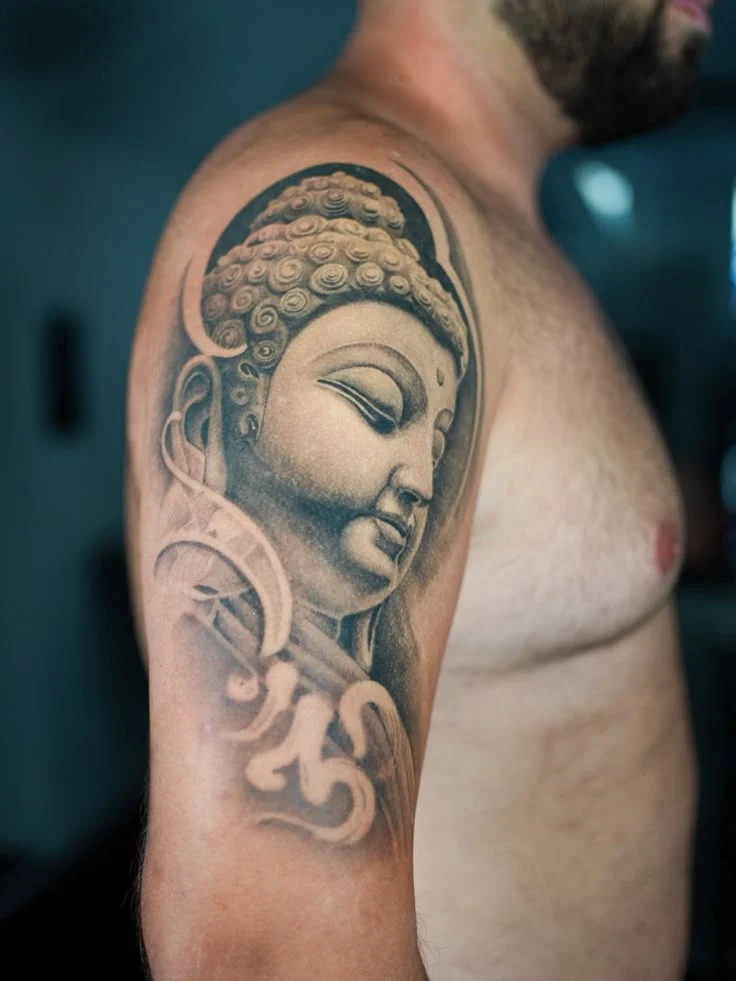
Serene Buddha Face in Black and Grey
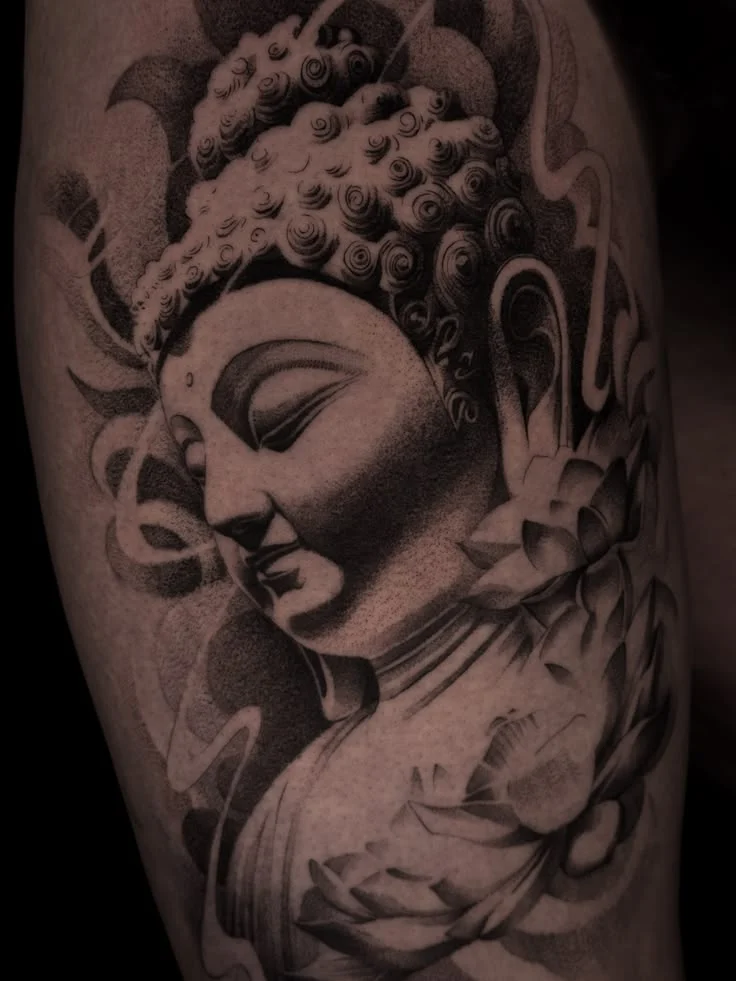
This healed piece sits on the upper arm and shows a Buddha face in profile, eyes closed, with spiral curls and soft smoke around it. Closed eyes look inward, so the design reads as inner peace and balance rather than a single story. Strong contrast between the dark background and lighter face keeps the features clear once healed. It’s perfect for anyone who wants a daily reminder to slow down. The upper arm is a broad, stable area, so it’s ideal for a first larger piece.
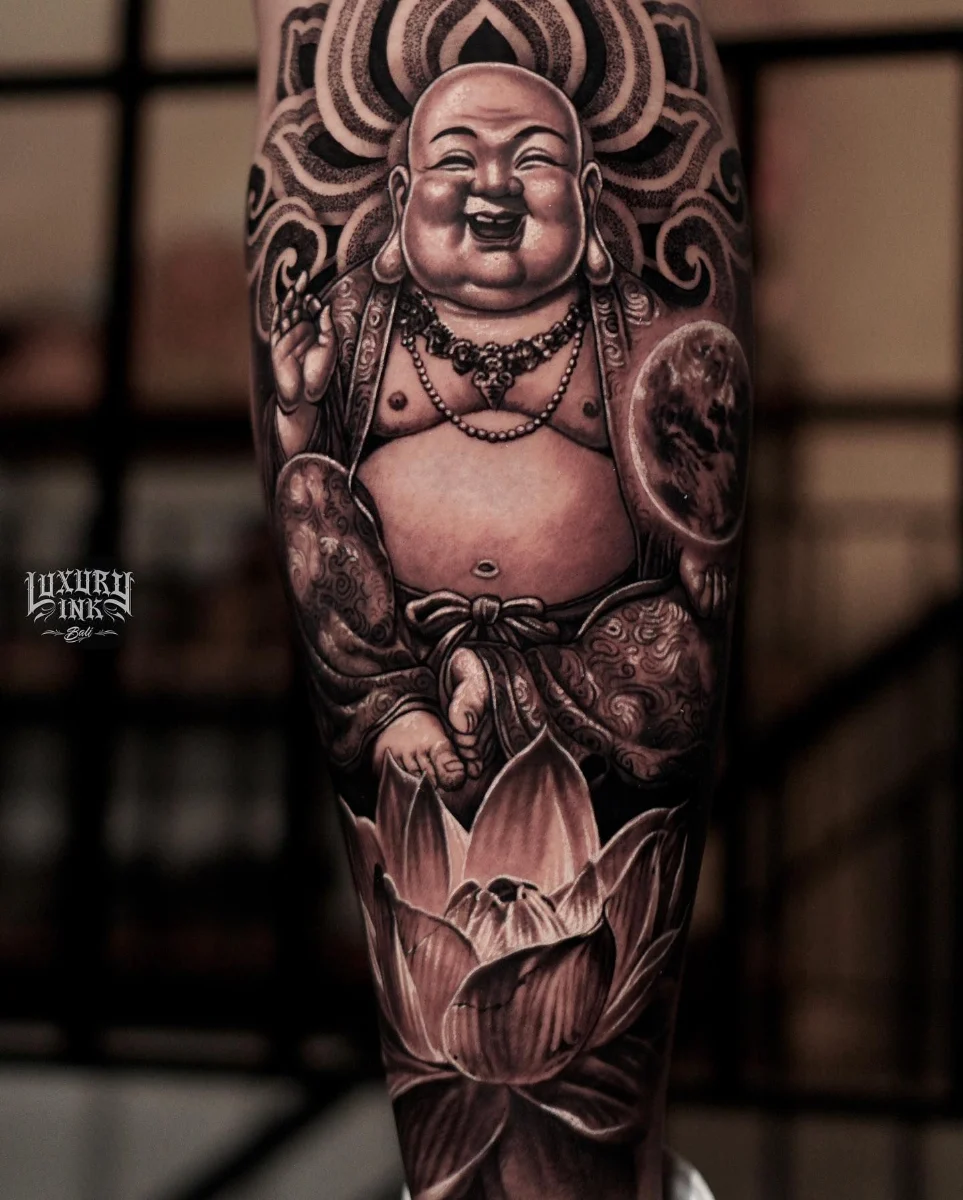
Laughing Buddha Above a Lotus
This is Budai, not Siddhartha Gautama. He is a cheerful monk with a round belly and prayer beads, seated above a lotus with a mandala behind him, in soft grey shading. Folk tradition treats Budai as a sign of plenty, contentment and good luck. The lotus adds a second layer, since it rises from muddy water and blooms above the surface. Many people read that as joy growing out of hard times. A long sleeve gives it room, so it’s great for anyone who wants a warm, friendly piece.
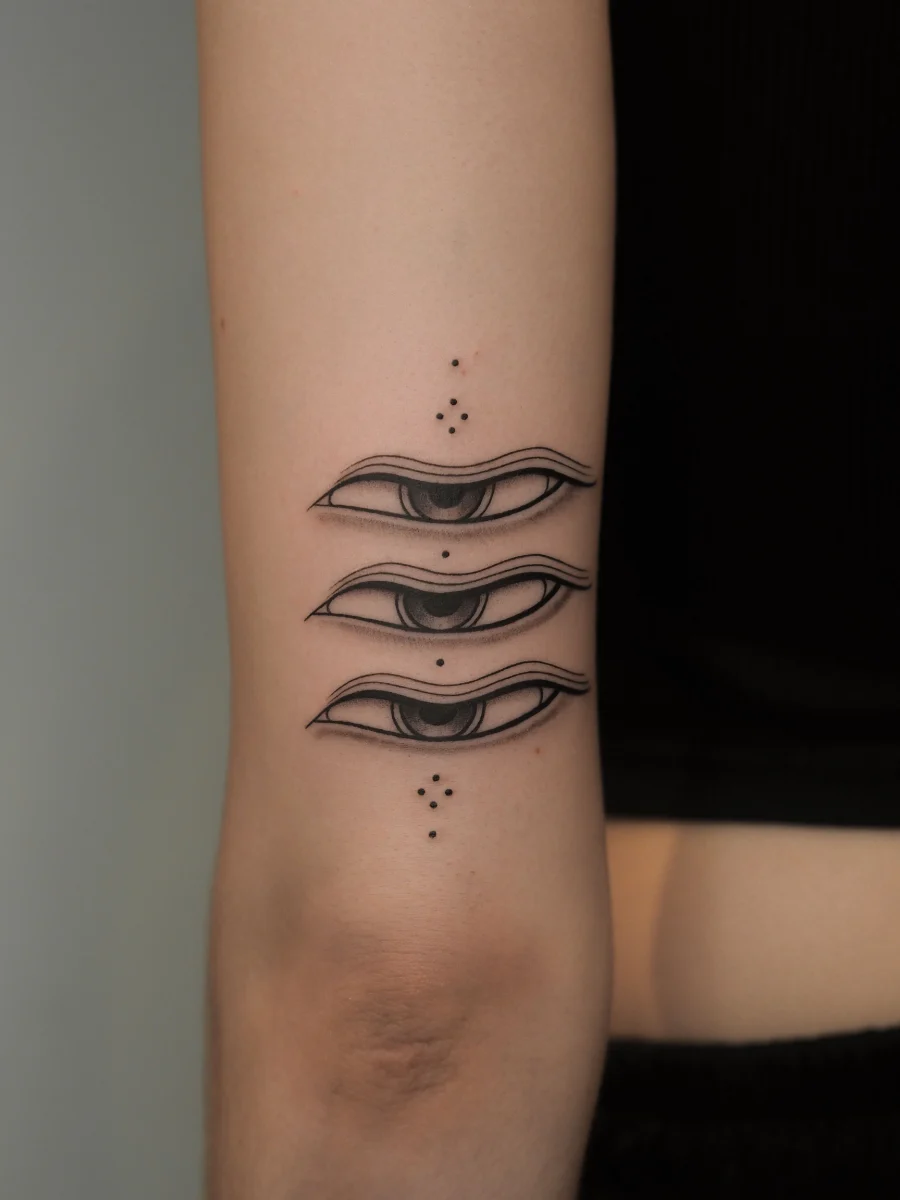
Buddha Eyes on the Back of the Arm
Three pairs of wisdom eyes are stacked down the back of the arm, drawn in thin lines with small dots above and below. The eyes echo the gaze painted on many Buddhist stupas and are often tied to awareness and seeing clearly. Because the design is small and made of simple shapes, it makes a good first tattoo for anyone who likes a minimal look. Thin lines need a little care. Keep each pair large enough for the dots to stay distinct as the tattoo ages.
Cosmic Buddha With a Glowing Lotus
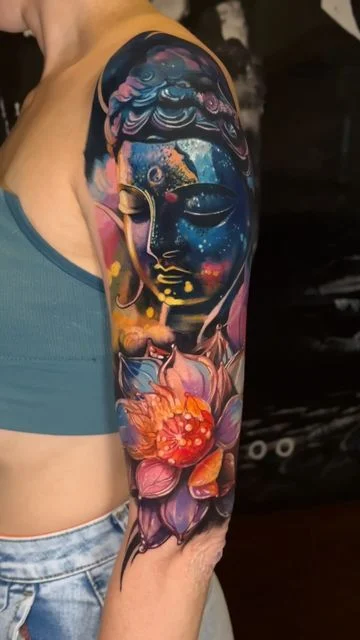
Here a Buddha face glows in blue and violet, like the night sky, and a pink and orange lotus sits beneath it. The galaxy suggests a mind as wide as the universe, and the lotus means purity rising from mud. This is color realism, so strong contrast keeps the face clear of the background. A half sleeve is ideal for anyone who loves bold color, and once it has healed, use sunscreen regularly, since light colors tend to fade sooner in the sun.
Buddha With the Silence Gesture
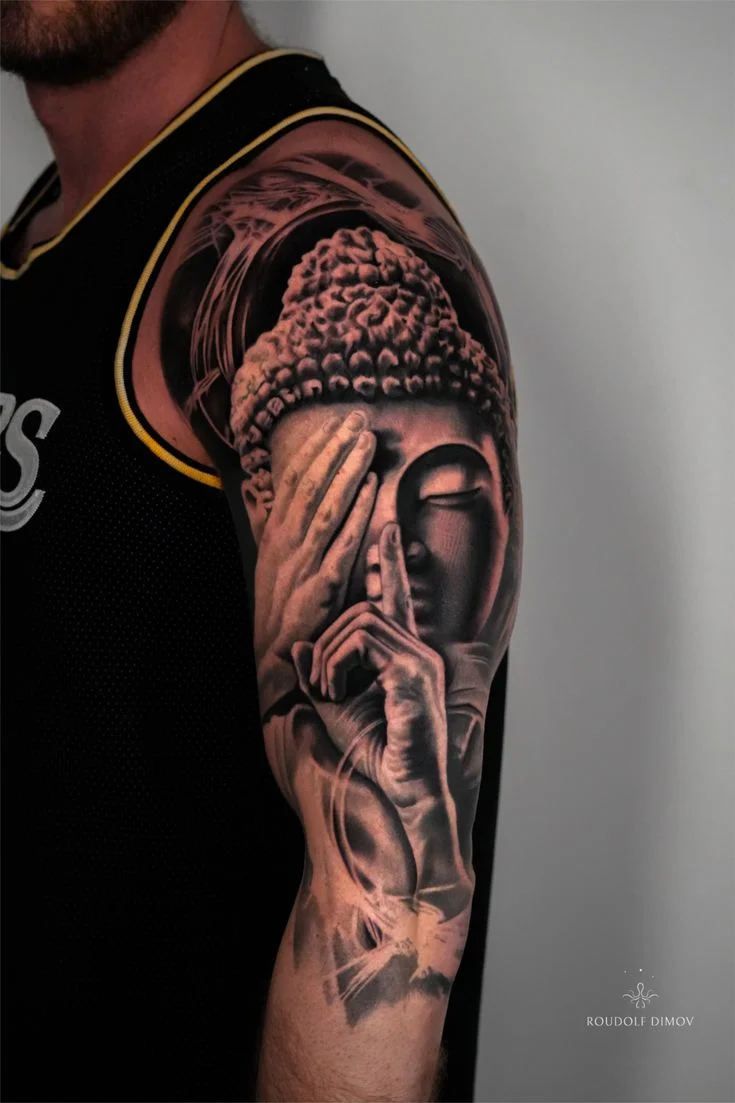
A stone Buddha statue covers one eye with a hand and presses a finger to its lips, with smoke curling from the shoulder. The pose echoes the familiar “see no evil, speak no evil” idea, but it’s a modern composition, not a traditional mudra. Black and grey shading gives the figure the weight of carved stone. It’s a good pick if you’re learning to pause before speaking, or to judge less quickly. The shoulder and upper arm give the pose width, and the hand needs extra space for clean fingers.
Buddha and Crane Panels
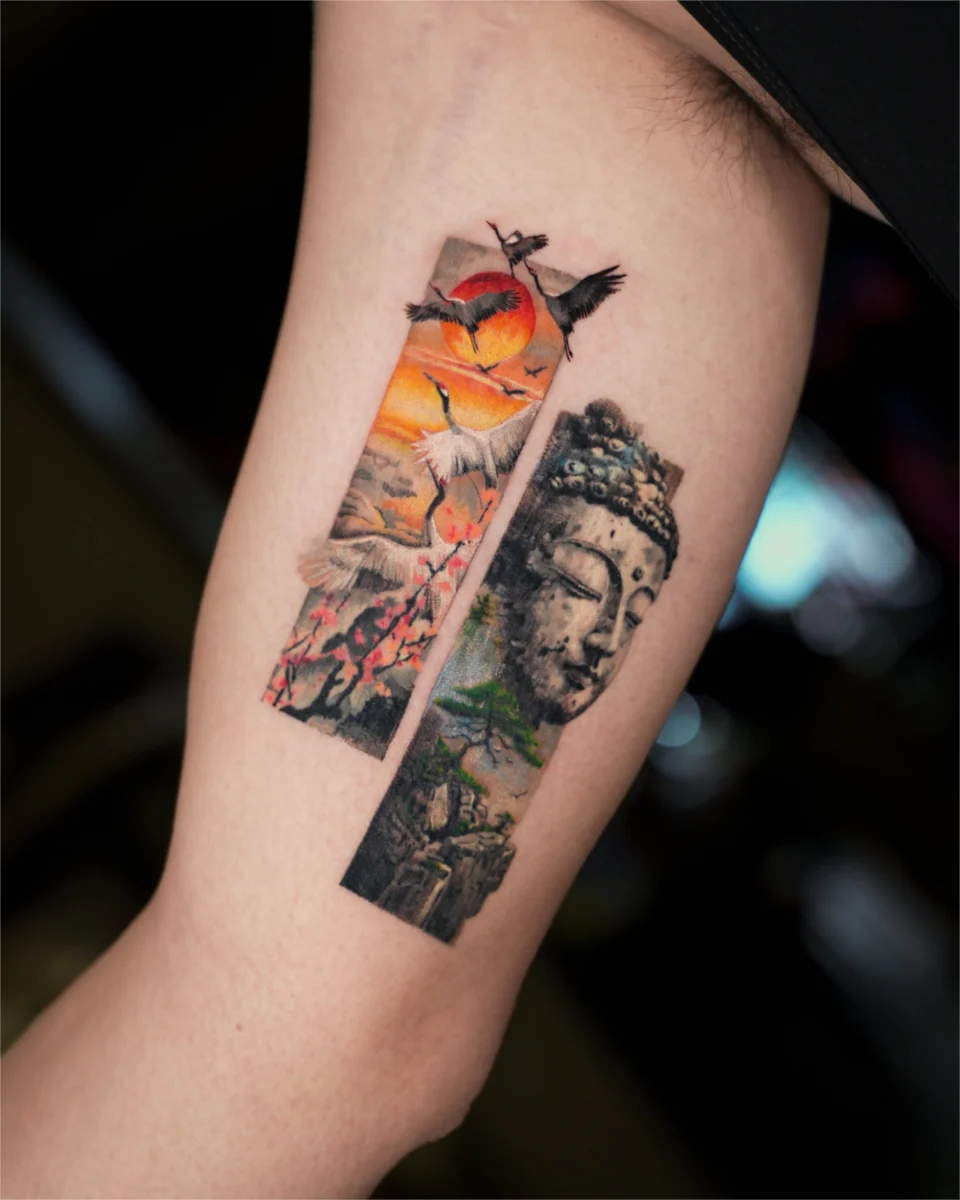
This inner-arm piece splits into two tall frames, with a red sun rising behind cranes and cherry blossoms on the left and a Buddha face beside a pine branch on the right. In Japanese symbolism, cranes are often seen as a symbol of long life and pine trees of endurance, so together they suggest a long life lived with a quiet mind. The two-panel layout fits naturally along the inner arm, giving each scene room to stand out. This one works best for anyone who wants two values in one compact design.
Fine Line Laughing Buddha With a Dharma Wheel
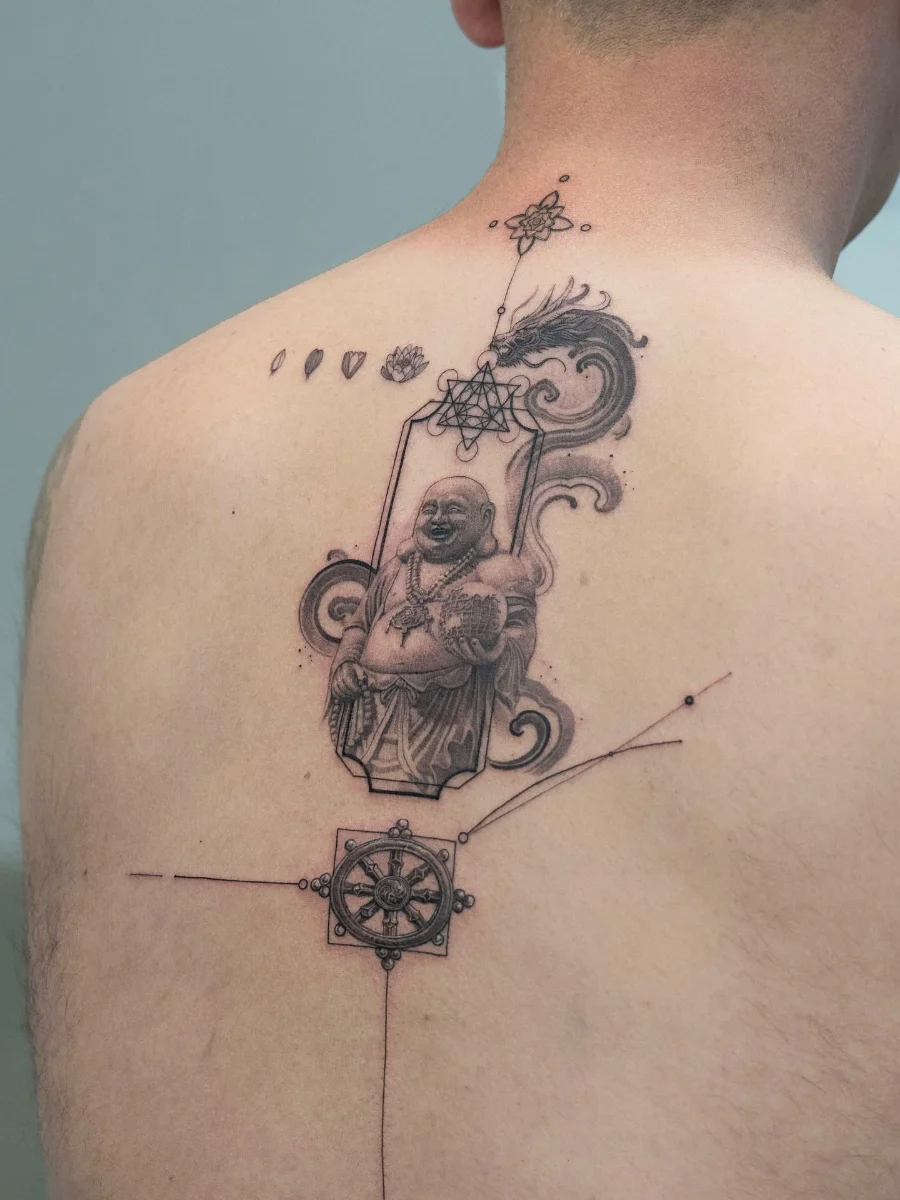
A small laughing Buddha sits in a sacred geometry frame near the upper spine, with a dharma wheel below and a line running down the back. The wheel’s eight spokes represent the Eightfold Path, and the vertical line suggests a road to follow. Budai brings a light mood, so the piece reads as joy on the way. Fine line work keeps it delicate and easy to hide. Thin lines need touch-ups over time, but it’s a good fit for anyone who wants something gentle and private.
Fingerprint Line Buddha With Cherry Blossoms
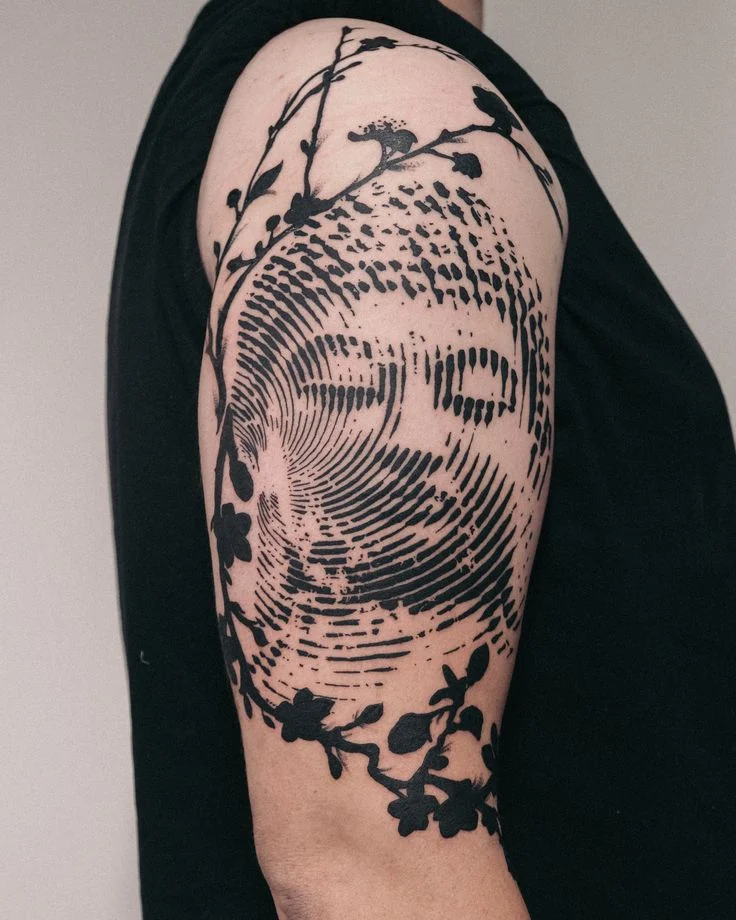
On the shoulder, a Buddha face is built from curving lines that look like a fingerprint, with a black cherry blossom branch wrapped around it. Every fingerprint is unique, so the lines can stand for a personal path toward calm. Blossoms are short-lived. They bring in impermanence, the idea that nothing stays the same. The look is graphic and a little modern, done in blackwork and linework. It’s a great pick for people who like clean, design-driven art over lifelike portraits, and the shoulder shows the pattern in full.
Cracked Stone Buddha Sleeve
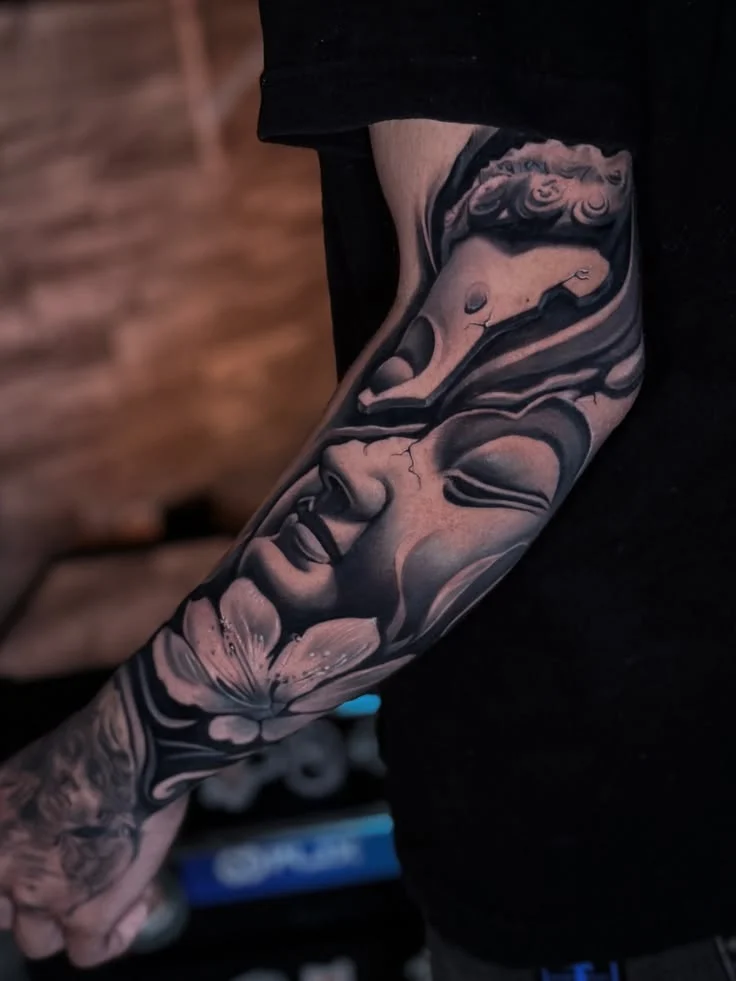
A cracked stone Buddha face extends across the forearm, surrounded by blossoms and drifting smoke, and the cracks across its calm face suggest that peace is still possible after hardship, so the design often speaks to people coming through loss, illness or a hard year. The vertical sleeve layout follows the arm, and black and grey shading gives the cracks real depth. Ask your artist to keep strong darks around the face, since those shadows are what hold the stone texture together once the tattoo has healed.
Standing Buddha With the Fearlessness Mudra
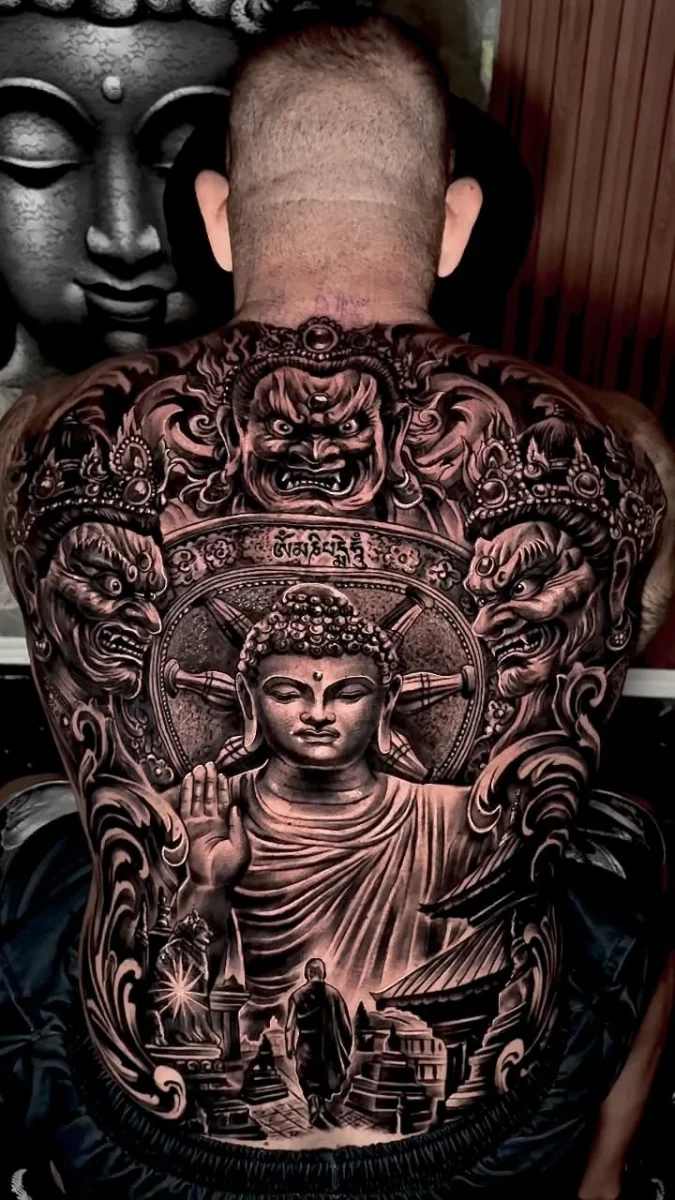
This full back piece shows a standing Buddha raising an open palm in the abhaya mudra, with a dharma wheel behind him. Fierce guardian faces stand on both sides, and a temple with monks sits at the bottom. The raised palm means fearlessness, and the guardians add protection around the figure. A large project that takes several sessions, it’s best for someone who wants a major, protective piece. Plan the layout with your artist first, because a design this big has to follow the back’s shape.
Choosing a Style for Your Buddha Piece With Holistic Ink
Many styles work for a Buddha piece, and the one you pick changes how the face reads, how the tattoo ages and how much room it needs. Our artists at Holistic Ink work across several styles, and three of them suit different versions of this subject. Our portfolio doesn’t include a Buddha piece yet, so the three examples below show the same techniques you would be choosing between, applied to other subjects.
| Style | How the Buddha looks | Best size and placement | How it ages | Best for |
|---|---|---|---|---|
| Black & Grey Realism | Carved stone, soft smoke, deep shadows | Medium to large, upper arm, chest or back | Holds depth well when the darks are strong | A calm, statue-like face |
| Color Realism | Glowing lotus, warm robe, light behind the head | Medium to large, shoulder or back | Needs sun care to keep the blends | A vivid, eye-catching piece |
| Japanese / Irezumi | Bold outlines with clouds, waves and wind | Large, chest, sleeve or back | Reads clearly from far away | A story told across a big area |
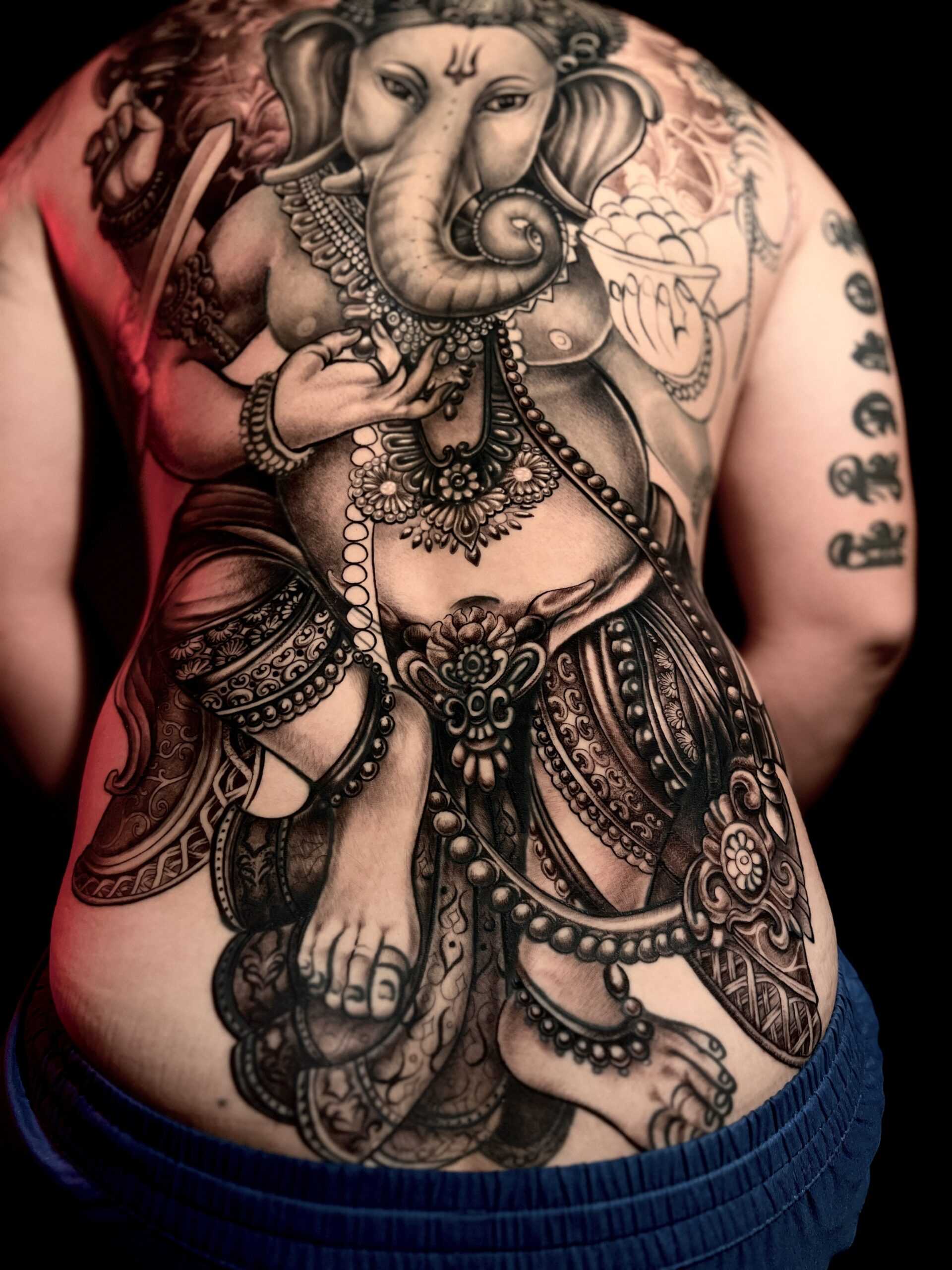
Black and grey realism builds a face from smooth gradients, soft smoke and fine texture, so a stone Buddha looks almost carved, and the Ganesha back piece below shows this well, with chiseled detail in the figure and beads that look heavy enough to touch. That depth is the advantage: a serene face gets real volume and ages well when the contrast sits in the deep darks. For a calm, statue-like look, this works best. It isn’t ideal for a very small face, since fine facial details can blur when the design is scaled down to a few inches.
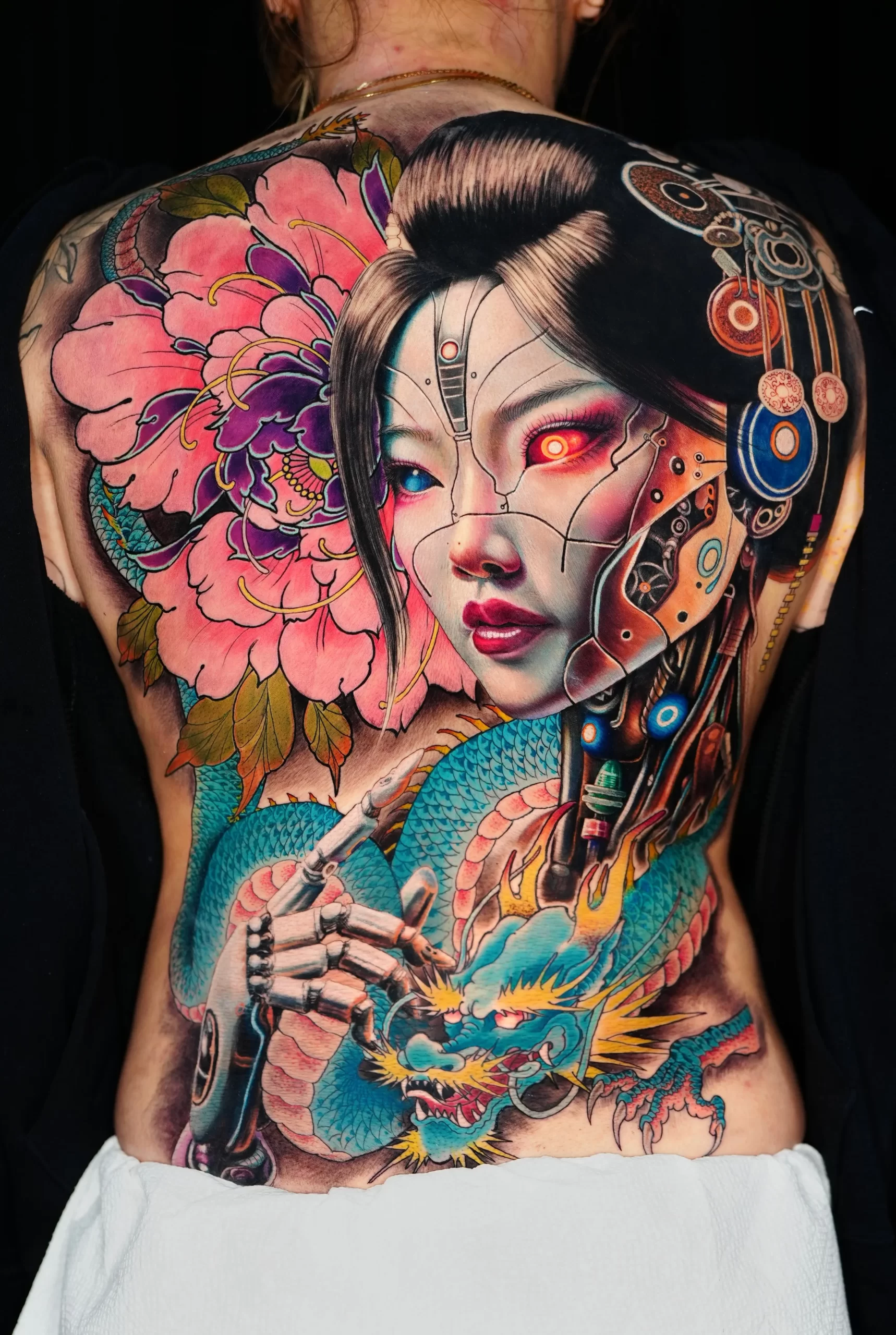
Color realism layers hue and light, a strong match for the lotus, the saffron robe and the glow behind a head. The back piece below, with a geisha, peonies and a jade dragon, shows how smooth color blending can give a large scene depth and unity. For a Buddha design, that means a pink and orange lotus that seems to glow and a halo that reads as real light. The benefit is a piece that stands out the moment someone sees it, though the trade-off is sun exposure, which can fade color over time and call for sunscreen and the occasional touch-up.
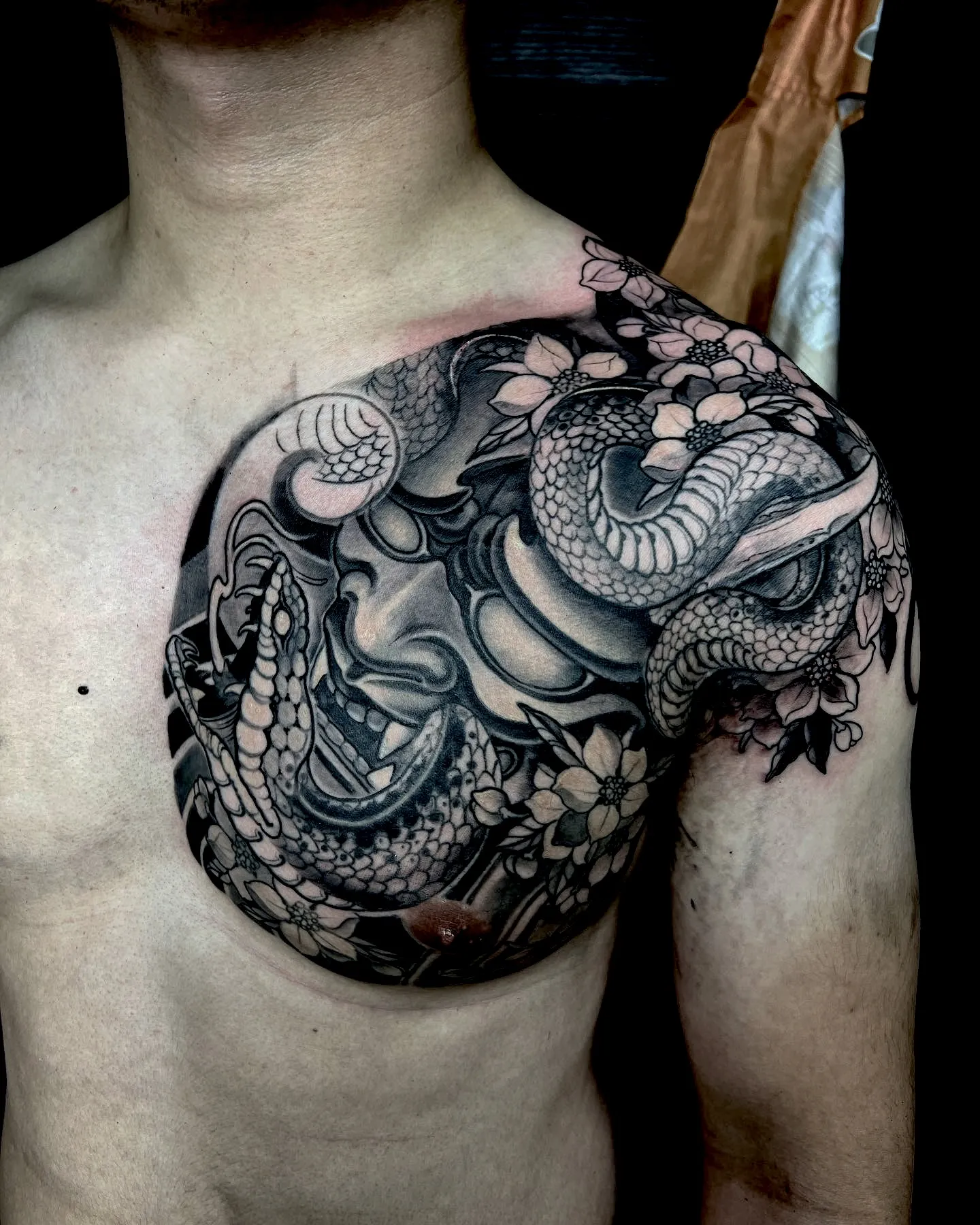
Japanese and Irezumi work uses bold outlines with clouds, waves and wind bars to carry a story across a large area. The foo dog below, a guardian that traditionally watches over temple gates, shows how a Japanese background can tie the figure into one shape across the chest and shoulder. Consider this style for Kannon, a Buddha with a dragon, or a standing figure flanked by guardians. It reads clearly from across a room and usually holds up well over time, though it isn’t ideal if you want something small and discreet.
Beyond these three, fine line, dotwork and blackwork suit smaller ideas such as wisdom eyes, a dharma wheel or a single lotus. Keep the design simple, because tiny lines soften as skin changes.
Respect, Common Mistakes, Cost Factors and Longevity
Images of the Buddha are sacred in many Buddhist cultures, and that deserves a moment of thought before you commit. In countries such as Thailand, Sri Lanka and Myanmar, a figure of the Buddha is treated with deep reverence, and visitors in some countries have been turned away or asked to cover up when a tattoo was seen as disrespectful. In many Buddhist cultures, keeping the figure above the waist and away from the feet is seen as respectful. Avoid pairing it with jokes, alcohol or anything sexual, and learn what your design means, including whether it shows Siddhartha Gautama or Budai. Many practicing Buddhists wear these images themselves and customs vary by community, so the point is care, not fear.
The most common mistake is shrinking a face until the eyes and nose blur together. A second is mixing up Budai and Siddhartha Gautama. Packing in too many symbols is a third, since a lotus, a wheel, a mandala and a crane all compete with the face for space. For Sanskrit or Tibetan script, have the spelling checked against a trusted source before the stencil goes on, because a wrong character is hard to fix later.
Price depends on several factors and not on a flat rate, with size the biggest, followed by the amount of face detail, whether the piece is color or black and grey, where it sits on the body and how many sessions it needs. Custom drawing takes longer than flash. An artist can only quote a price after seeing your idea and the spot, so ask about cost at your consultation with Holistic Ink.
A face needs enough contrast to hold its shape. Dark areas around the face keep the features readable as the skin changes, while very light shading and pale color tend to soften sooner. Regular sunscreen is one of the best ways to slow fading on a healed tattoo. A touch-up can sharpen an area that softens. Healing differs from person to person. Ask your artist what to expect, and don’t judge the result until the skin has fully settled.
Best Placements for a Spiritual Design
Placement carries meaning here, so give it as much thought as the design. A common rule is to keep the figure above the waist and close to the heart or head. Because a face needs a flat surface, the shoulder, outer upper arm, chest and back are usually the best choices. Tall designs such as a standing Buddha or a cracked stone sleeve follow the forearm, while wide ones such as a reclining Buddha fit the chest or ribs. The table lists common spots and the designs that suit them.
| Area | Pain level | Buddha design that fits | Style that suits |
|---|---|---|---|
| Upper arm / shoulder | Low | Serene face, silence gesture | Black & grey realism |
| Forearm | Low to moderate | Cracked stone sleeve, reclining Buddha | Black & grey realism |
| Back of the arm | Moderate | Wisdom eyes, small dharma wheel | Fine line |
| Chest | Moderate to high | Face with lotus, Budai | Black & grey or color realism |
| Upper back / spine | Moderate to high | Fine line Budai with dharma wheel | Fine line, geometric |
| Full back | High in places | Standing Buddha with guardians | Realism or Japanese |
Pain varies by person. Treat the second column as general guidance, not a guarantee. Ribs and the spine tend to feel sharper than the upper arm for many people, and large back pieces are often completed over several sessions.
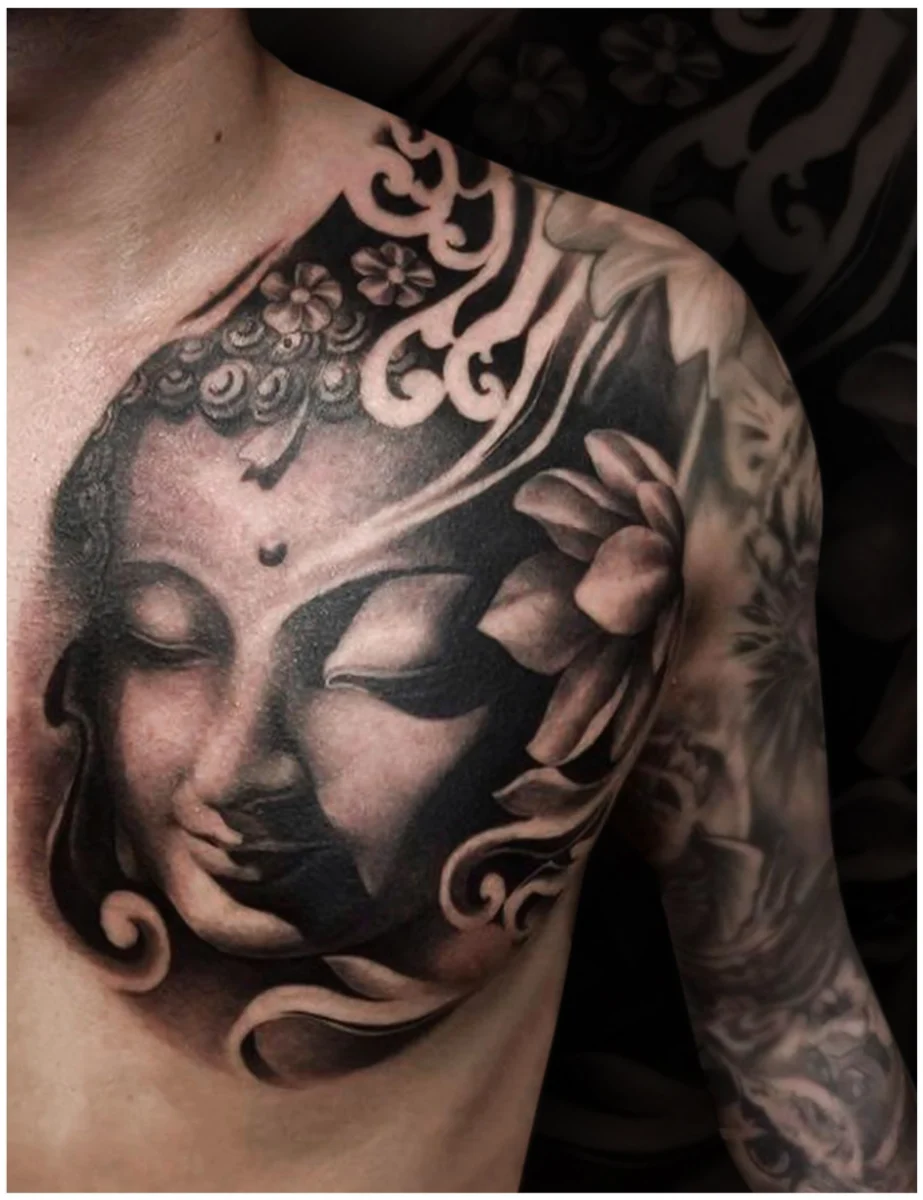
The chest and shoulder offer a broad, curved area for larger compositions. Here a Buddha face and lotus spread across both areas, following the collarbone and arm in a way a small design could not.
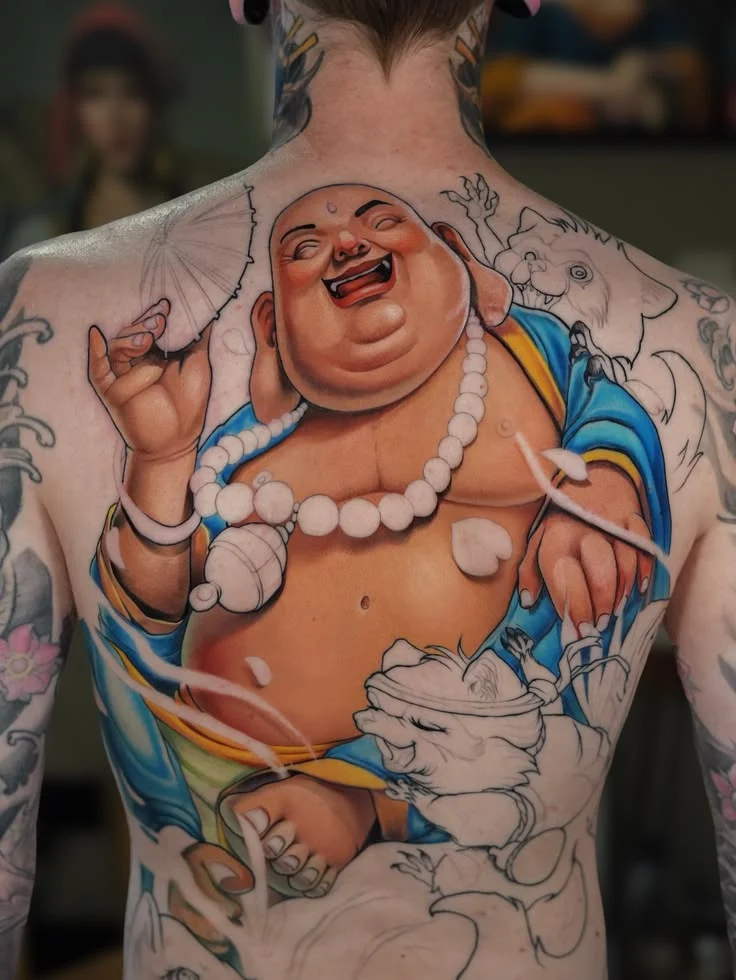
The back gives the most room for a large figure. This full-color Budai is shown after its fourth session, with sketch lines still visible near the bottom, which is a useful reminder that a big piece takes time to build. To stay respectful of tradition, skip the lower thigh, calf and foot, and tell your artist at Holistic Ink how you’ll wear the tattoo day to day. A strap, a collar or a waistband can rub a spot and change how it heals, so a good layout plans around each of them.
Steps From Consultation to a Healed Piece
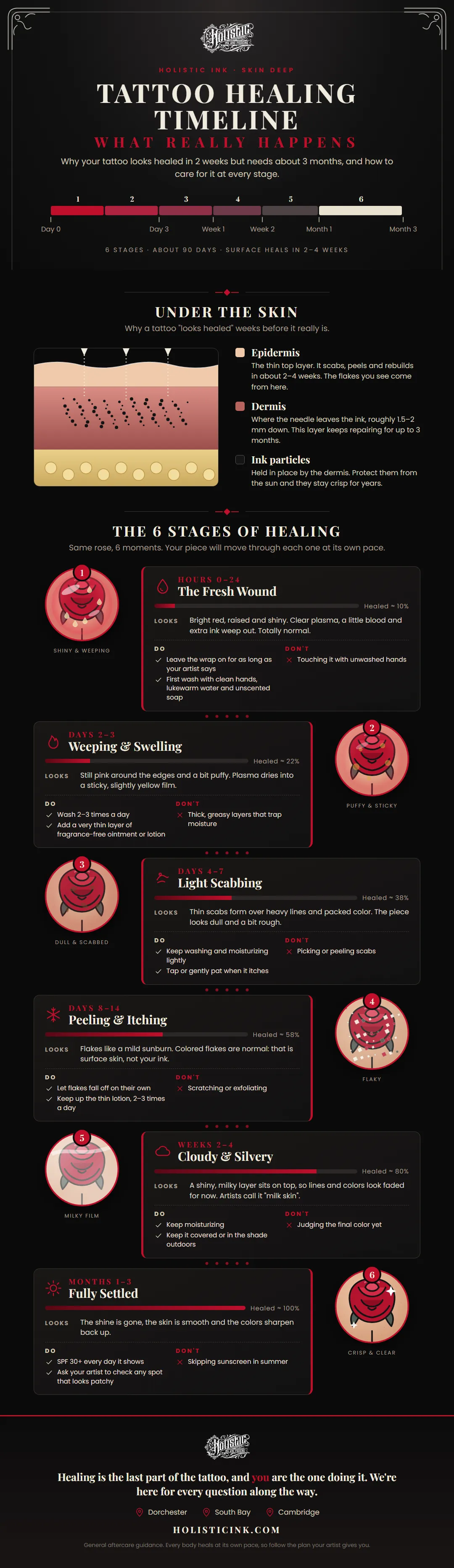
Every tattoo follows the same path from idea to healed skin, and knowing the order takes the stress out of a first visit. The infographic below outlines the healing timeline, and the steps before it matter just as much.
It begins with a consultation. You talk through the meaning, if you want Siddhartha Gautama or Budai, the mudra, and the spot you have in mind, and bringing photos of real statues, ideally from a straight-on angle, helps your artist get the face right. A front view shows how the eyes, nose and mouth line up along the center, and a side view gives the artist the profile, so the proportions stay true. You don’t need every detail decided, since refining the idea together is half the point of the visit.
Next comes the stencil. The artist places the design on your skin, and you stand up and check it in a mirror. For a face, this is when the artist balances both sides and straightens the line of the eyes. Check that the eyes sit level and that the center line runs straight down the nose and mouth. If anything looks off, ask for changes now, not after the needle starts.
During the session, the artist usually works on the lines and main shapes first and adds shading afterward. Large areas are often split across several visits, so a big piece may take more than one day. Eat beforehand, stay hydrated and say so if you need a break.
Aftercare starts right away, and the first couple of weeks matter most. Keep this short list close while the skin heals:
- Wash, dry and moisturize the way your artist showed you.
- Keep the tattoo out of direct sun.
- Stay away from pools, hot tubs and the ocean until it heals.
- Don’t scratch or pick at the skin as it flakes.
- If the itching gets hard to ignore, ask your artist what helps.
Once the piece has settled, keep it in good shape with daily sunscreen and a bit of moisturizer. Once the skin has fully healed, ask your artist about a touch-up if a light area looks faded. The team at Holistic Ink is happy to look at how a piece has healed if something seems off.
Frequently Asked Questions
Is a tattoo forbidden in Buddhism?
There is no single rule that bans tattoos across all of Buddhism. Many Buddhists and monks wear them, including the sak yant designs known in Thailand. What matters most to practitioners is the intention behind the design and the respect shown to the image, so choose placement and subject matter with that in mind.
Is a Buddha design considered good luck?
It depends on the figure. Budai, the laughing Buddha, is linked with good fortune and plenty in folk tradition, so many people see him as a lucky symbol. Siddhartha Gautama is more about awakening and calm than luck, so a seated or meditating figure speaks to focus and not to fortune.
How small can a Buddha face be and still read clearly?
A face needs enough room for the eyes, nose and mouth to stay separate over time, and your artist will suggest a minimum size for the area you choose. If you want something small, pick a simpler symbol such as wisdom eyes, a dharma wheel or a lotus, which hold their shape better at a modest scale.
Can I work out or swim after getting tattooed?
Skip pools, the ocean and hot tubs until the surface has healed, since soaking can irritate the skin. Light exercise is usually fine once you feel ready, but avoid anything that rubs or stretches the area, wipe sweat away gently, and follow your artist’s notes.
Bring Your Buddha Idea to Holistic Ink
From the serene face to the standing figure with guardians, each of these ten designs carries a meaning of its own, so pick the one that speaks to you, then think about where it will sit and how it will age. When you’re ready, book a consultation at our Boston studio and bring your references, and our artists will help you shape the idea into a piece that feels calm and holds up over time.
Take your Buddha tattoo further
A Buddha design can grow into a full sleeve or backpiece. Our artists are known for large-scale work in 3 styles. Start with the one that fits your idea:
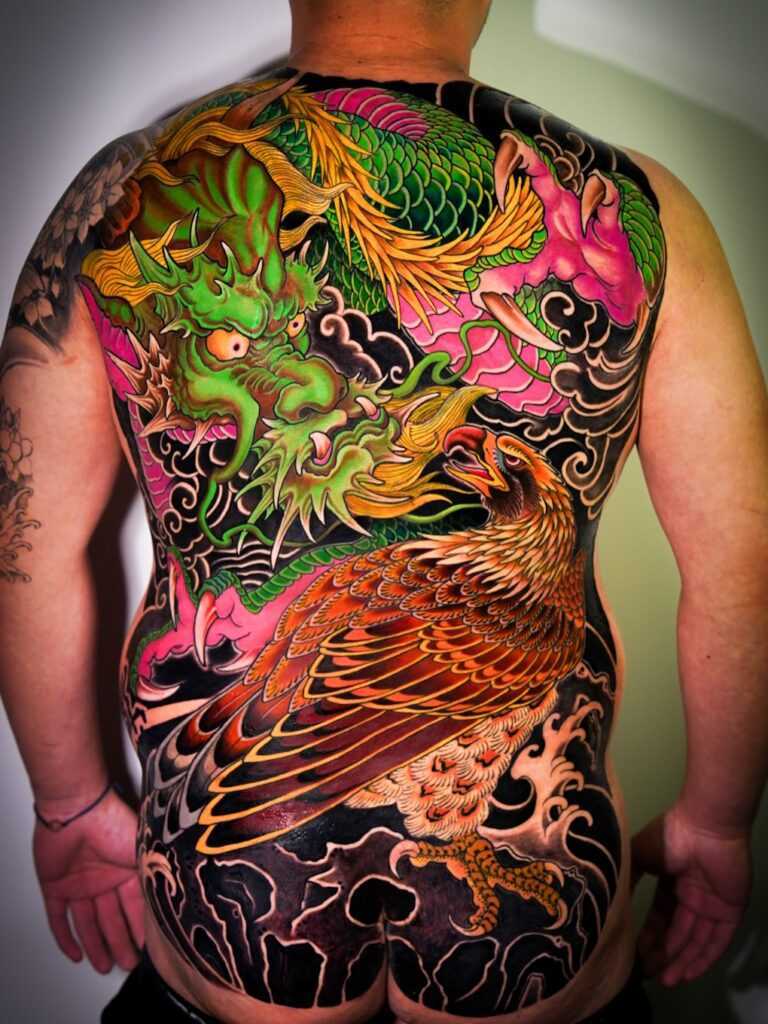 Best matchJapanese IrezumiDragons, koi, deities and full backpieces with traditional flow.
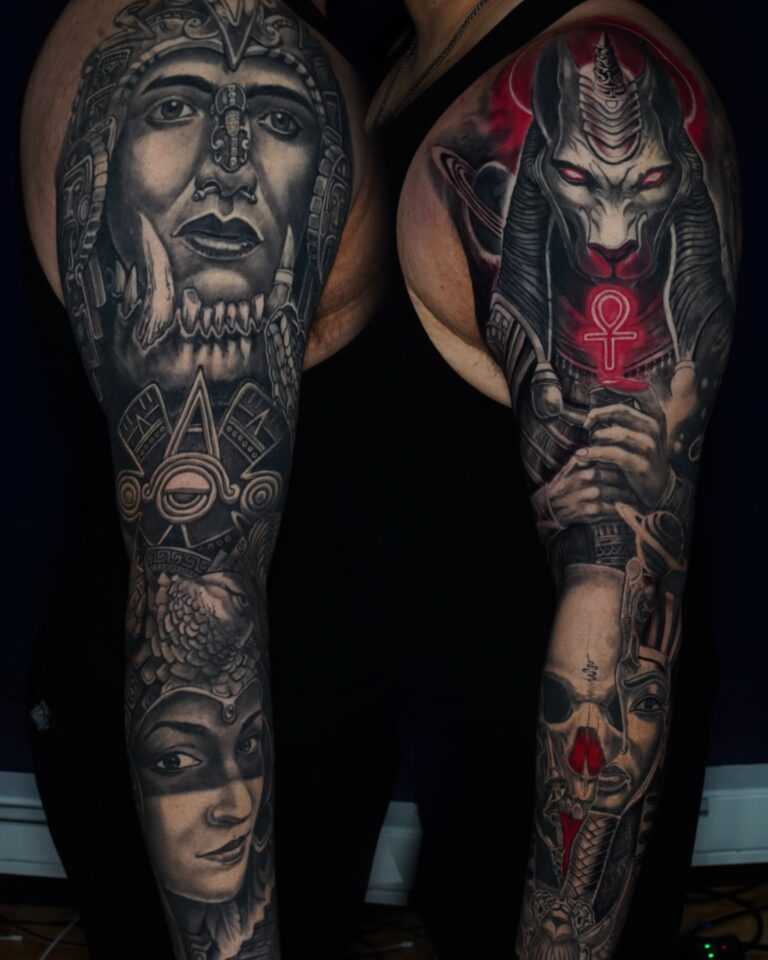 Black & Grey RealismPortraits, animals and sacred art in soft, deep shading.
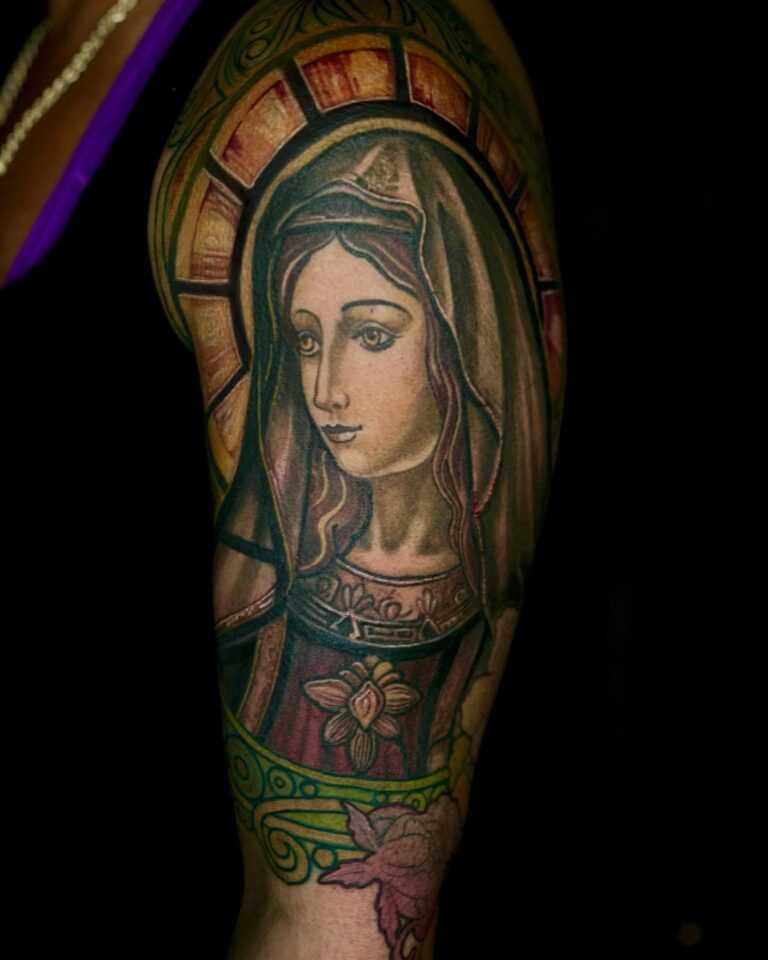 Color RealismSaturated, lifelike color for sleeves and large scenes.
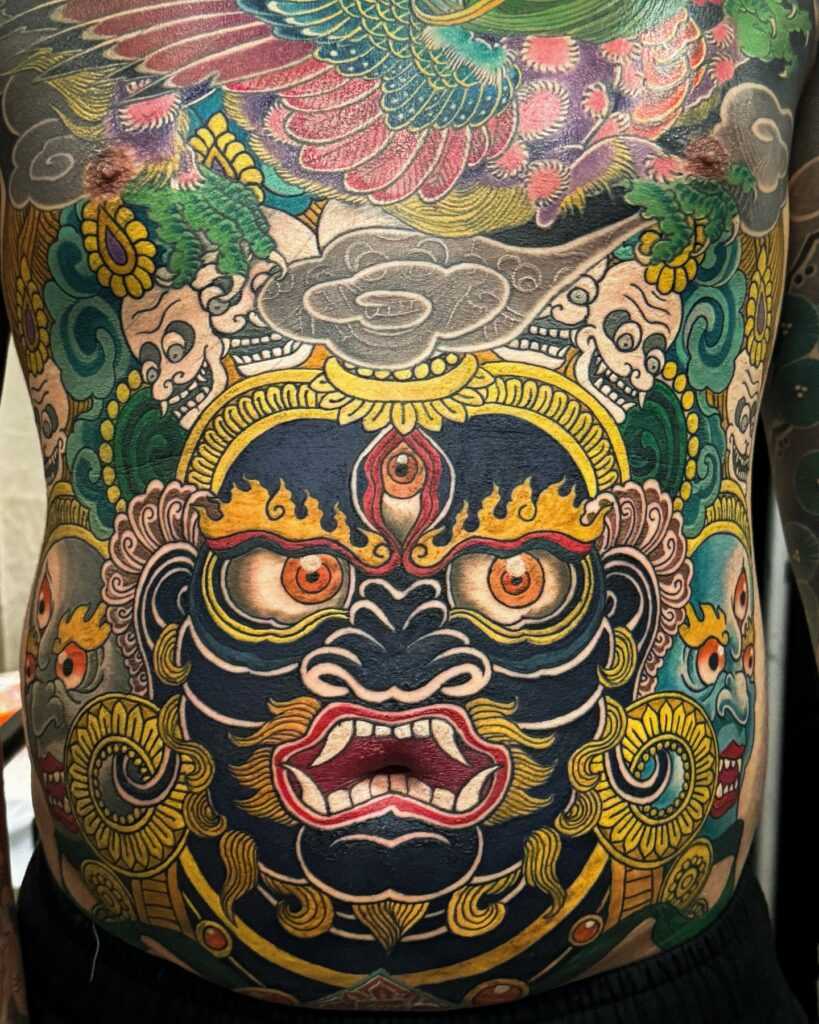 Signature project · Japanese IrezumiMahakala: Wrathful Protector Front PiecePlacementFront torsoSubjectMahakalaArtistsCollaboration with Vinny NguyenSee the full project →
Bring your reference and placement. We plan large work session by session with you.
We also tattoo American traditional, fine line, script and small tattoos. Browse all styles →